
Short answer: Ask what size refrigerator for family of four households need and the makers themselves give different answers. Samsung's US size guide puts 3 to 4 people at 15 to 20 cubic feet. GE Appliances' size guide says 18 to 25. GE's own buying guide says 25 or more. The band where Samsung, GE's size guide and Consumer Reports' summary of maker advice all overlap is 19 to 20 cubic feet. Start there, adjust for how your household shops, and confirm the fridge fits the opening before capacity matters at all.
That overlap is not a rule of thumb we made up. It is simply where the published ranges agree, and the rest of this guide shows you where each number comes from, what a cubic foot on a spec sheet actually counts, and how to move up or down from the middle without being talked into the showroom's biggest box.
What size refrigerator for family of four: the published numbers side by side
Every figure below was read on September 23, 2026, on the source's own page. Two things stand out. The ranges barely overlap, and the most repeated number, 25 cubic feet, sits at the very top of one maker's range.
| Source | Household band as written | Capacity it gives |
|---|---|---|
| Samsung US, "What Size Refrigerator Do I Need?" | 3 to 4 people | 15 to 20 cu. ft. |
| GE Appliances, refrigerator size guide | 3 to 4 people | 18 to 25 cu. ft. |
| GE Appliances, refrigerator buying guide | "a typical family of four" | 25 cu. ft. or more |
| Consumer Reports, refrigerator buying guide | family of four, reporting what "most refrigerator manufacturers recommend" | 19 to 22 cu. ft. |
The same two sources also chart the other household sizes. Samsung's US refrigerator size guide, read on September 23, 2026, lists 10 to 14 cubic feet for 1 to 2 people and 21 or more for 5 or more people. GE Appliances' refrigerator size guide, read the same day, lists 12 to 16 for 1 to 2 people and 25 or more for households of five or more or anyone who "hosts frequently." If your household is about to change size, the way it changes the rest of the kitchen is covered in sizing a kitchen to the household, from one person to six, and the fridge follows the same logic.
Why one maker can give you two answers
GE Appliances is the clearest example. Its size guide gives 3 to 4 people a band of 18 to 25 cubic feet. Its buying guide, read on September 23, 2026, says "a typical family of four is likely to be fine with a refrigerator that measures 25 cubic feet or more." Both statements are hedged, and neither is wrong. But the second one takes the ceiling of the first and turns it into a floor.
Our reading of why this happens: a sizing guide is written so that the heaviest-shopping family in the band is never short of room. A household of four that buys in bulk, keeps two teenagers fed and hosts on weekends lands at the top. A household of four that shops twice a week lands near the bottom. When a single number gets repeated in a showroom or a dealer blog, it is almost always the top of the band, because nobody returns a fridge for being too big.
So the honest way to read the table is not "which source is right" but "which end of the band am I." That depends on four things about your household, covered below, and on one thing about your kitchen that overrides all of them.

What the cubic-foot number measures, and what it leaves out
Capacity on a spec sheet is interior volume. Most maker spec pages list a total figure and then split it into fresh-food capacity and freezer capacity. That total is the number on the showroom tag, and it is the number the charts above are built around.
The problem is shape. A cubic foot spread across door bins, an ice maker housing, crisper drawers and the gaps around shelf supports does not hold what a clear cubic foot of shelf holds. Consumer Reports, whose lab measures this, states in its refrigerator buying guide (read September 23, 2026): "Our tests have found that the amount of usable storage is often less than what's claimed by manufacturers." In its section on French-door models it goes further: "Actual storage capacities may be much less than claimed."
That is why GE's buying guide says "the best way to know what capacity is right is to take a look inside," and suggests opening the doors to check whether shelves can be "repositioned, taken out or slid out of view," and whether you can fit "tall items like beverage containers" and "wide items like pizza or birthday cakes."
Two practical consequences:
- Compare the split, not just the total. Two refrigerators with the same total can divide it very differently between fresh food and freezer. A household that shops fresh several times a week should compare the fresh-food figure. A household that batch-cooks and freezes should compare the freezer figure.
- Compare within one configuration. Door layout changes how usable the space is. Configuration tradeoffs get their own guide on this site, so here the rule is simple: when you compare capacity numbers, compare models of the same style.
Four questions that move your number up or down
Start at the 19 to 20 cubic foot overlap. Each question below pushes you toward the top of the GE band or the bottom of the Samsung band.
How often do you shop?
This is the biggest single factor. A weekly or biweekly stock-up has to fit all at once, so it pushes you up. Several smaller trips a week spread the load, so they let you go down. If your plan for a new home leans on buying staples in quantity, the way the core stock for a new home pantry does, remember that the dry goods live in the pantry and only the chilled and frozen share lands in the fridge.
Who is actually eating?
Every chart above counts heads, not appetites. A family of four with two toddlers and a family of four with two teenagers are not the same household, and the charts cannot tell them apart. If your four includes older kids or adults who pack lunches, read the upper half of the band. If two of the four are small children, the lower half is reasonable.
Is there a second freezer or fridge?
A garage chest freezer or a second refrigerator takes the bulk load off the kitchen unit. If you have one, or plan to, the main fridge can sit at the lower end, and the freezer share inside it matters less.
Do you host?
GE's size guide puts "5+ or hosts frequently" in the same row, at 25 cubic feet or more. That grouping is useful: a family of four that regularly feeds eight should size like a household of five or more, at least for the fresh-food side.
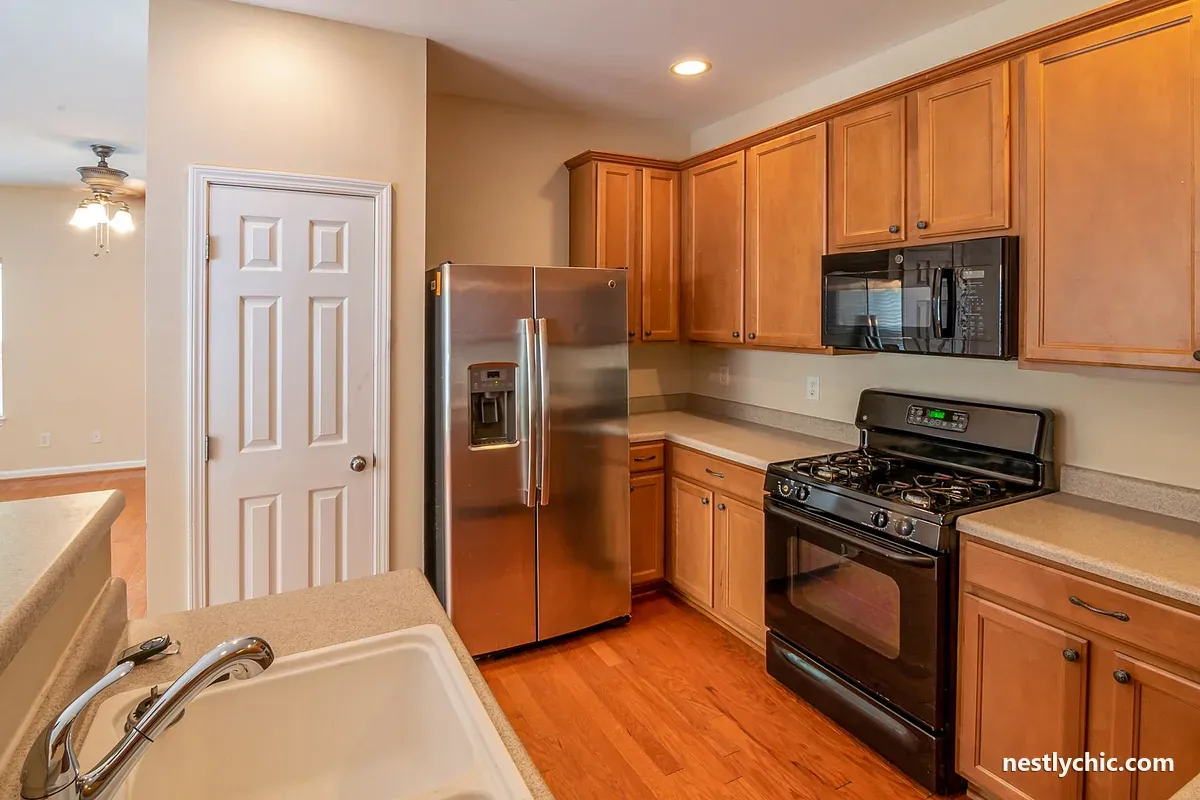
The opening decides before the headcount does
In a kitchen you own, the space the builder left for the refrigerator usually settles the question before the household chart does. Measure the opening first, because a capacity you cannot fit is not a choice.
Samsung's US size guide, read on September 23, 2026, says its refrigerators typically range from 66 to 73 inches tall, 23 to 36 inches wide and 26 to 37 inches deep. It gives a standard full-size French-door model as about 70 inches tall, 36 inches wide and 36 inches deep, and counter-depth models at 28 to 32 inches deep, excluding handles. Set those against your cabinets: standard kitchen cabinet dimensions explains why a standard-depth fridge sticks out past the counter and a counter-depth one sits closer to flush.
Depth is also where capacity goes. LG's refrigerator buying guide, read September 23, 2026, markets its Counter-Depth MAX line as delivering "the capacity you typically get in a standard-depth refrigerator" in a counter-depth design. That phrasing tells you the normal tradeoff: most counter-depth models give up some capacity for the flush look.
Clearance: the reason first, then the numbers
A refrigerator does not create cold. It moves heat out of the cabinet and releases it into your kitchen air, and it needs air moving around it to do that as designed. The doors also need room to swing wide enough for drawers to slide out. Those two jobs are why every maker asks for a gap, and why the gaps differ.
| Maker guide (read September 23, 2026) | What it asks for |
|---|---|
| GE Appliances size guide | At least 1 inch at the top and back; about 2 inches on the side the door swings open |
| Samsung US size guide | 2 to 4 inches on all sides, or at least 3/8 to 1 inch if space is really tight; 2 to 4 inches on the hinge side next to a wall |
| LG refrigerator buying guide | Subtract 1 inch from the smallest measurement of the opening for ventilation |
Three makers, three different instructions. The installation instructions for the exact model you are considering override every general guide, including these, so download them before you buy and check the opening against that page.
The route into the house
GE, Samsung and LG all tell you to measure the path, not just the space. Samsung's guide says to "map out a path from your entryway to your kitchen and measure the width of each hall, corner and doorway." Moving a full-size refrigerator is a job for the delivery crew, not a solo project. Your part is the tape measure, done before the order.
A worked way to pick your number
- Measure the opening. Height, width and depth, then subtract the clearance the model's installation instructions ask for.
- Start at 19 to 20 cubic feet. That is where Samsung's 15 to 20, GE's 18 to 25 and Consumer Reports' 19 to 22 all meet.
- Adjust. Weekly bulk shopping, older kids and frequent hosting move you toward GE's upper band. Frequent small trips, a second freezer and young children move you toward Samsung's.
- Check the split. Compare fresh-food and freezer capacity separately, within the same door style.
- Open the doors. Follow GE's advice and look inside with your tallest bottle and widest tray in mind.
- Measure the route. Every doorway, corner and hallway between the curb and the kitchen.
If a model passes steps 1, 5 and 6, a cubic foot or two either side of your target matters far less than the brochure suggests.
What this guide does not tell you
We have not tested any refrigerator, and nothing here is a product pick. The capacity and dimension figures are the makers' own, quoted from their pages on the date shown. Whether a particular model's usable space matches its label, and how reliable it is, are questions for a testing organization with a lab, such as Consumer Reports, which measures usable storage rather than repeating the spec sheet. Running costs are a separate question and are not covered here.
Once the new fridge is in, the paperwork is the next small job: registering a kitchen appliance warranty takes a few minutes and is easier with the model and serial numbers in hand on delivery day.
Frequently asked questions
Is 25 cubic feet too big for a family of four?
Not by GE Appliances' buying guide, which says a typical family of four is likely to be fine with 25 cubic feet or more. It is above Samsung's 15 to 20 cubic foot band for 3 to 4 people. Whether it is too big depends on how you shop: it suits weekly bulk trips and frequent hosting, and it is more space than a household that shops several times a week will fill.
Is 18 cubic feet enough for a family of four?
It sits inside both Samsung's 15 to 20 band and GE's 18 to 25 band for 3 to 4 people, and just below the 19 to 22 cubic feet Consumer Reports says most manufacturers recommend. It works best for households that shop often, have young children or keep a second freezer. For weekly bulk shopping it will feel tight.
Does a counter-depth refrigerator hold less food?
Usually. Samsung lists counter-depth models at 28 to 32 inches deep, excluding handles, which is less than most standard-depth models, and LG markets its Counter-Depth MAX line specifically as matching the capacity "you typically get in a standard-depth refrigerator," which implies most counter-depth models do not. Compare the capacity figures directly.
How much space should I leave around a refrigerator?
It depends on the model. GE Appliances asks for at least 1 inch at the top and back and about 2 inches on the door-swing side. Samsung asks for 2 to 4 inches on all sides, or at least 3/8 to 1 inch where space is really tight. The installation instructions for the specific model are the final word.