Knowing how to choose a kettle and toaster comes down to a handful of parts, not the price tag or the color. For a kettle, check what the water touches (plastic, stainless steel or glass), whether the heating element is concealed under a flat base, and whether it has automatic shut-off and boil-dry protection. For a toaster, check slot width and length against the bread you actually eat, a removable crumb tray, and room on the counter away from cabinets and curtains. These are the parts that decide whether you buy the appliance once or three times.
This guide covers choosing and placing the appliance. It does not cover descaling, cleaning routines or connected "smart" kettles.
Why cheap small appliances keep getting replaced
Kettles and toasters are usually bought quickly, often as a matching pair, and often chosen on looks. That is how a kitchen ends up replacing them. The parts that wear out, a shut-off switch, a lever mechanism, a heating element, are the parts nobody checks in the store.
The fix is not to spend more. It is to spend thirty seconds on the right questions. The two sections below walk through them, and the last section covers where each appliance should live on the counter, which matters more for safety than most shoppers expect.
If you are furnishing a whole kitchen at once, these two are good candidates for the "buy the plain, well-made version once" column. Our guide on where to spend and save in a first kitchen explains how to split the budget.
How to choose an electric kettle
What the water touches: the body material
The material question is really about the inside of the kettle, since that is what the water sits in.
- Plastic body. Light and cooler to hold, but look at whether the water sits against plastic or against a metal liner. Some plastic kettles have a stainless steel interior. If the listing says "BPA-free," that describes one chemical, not the plastic as a whole.
- Stainless steel. Durable and will not shatter if dropped. The outer wall gets hot, so the handle matters.
- Glass. Lets you see the water level and the boil, and shows mineral scale clearly. It can break, and it gets hot all over.
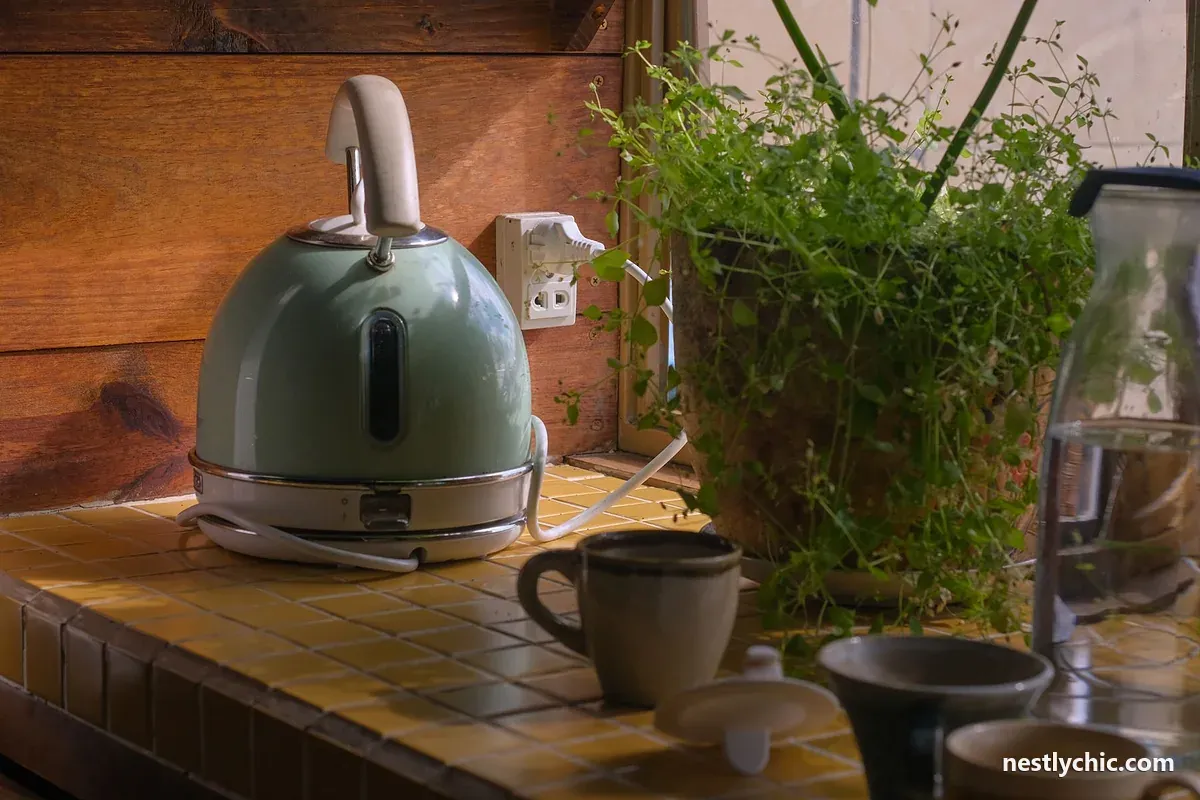
Whatever the material, the outside of a kettle can get hot. Ovente's product page for its KP72 electric kettle (read September 27, 2026), a plastic-bodied model with a stainless steel interior, carries a warning that the "kettle body might get extremely hot during operation" and tells users to hold the cool-touch handle to avoid burns. Treat a cool-touch handle as a requirement, not a bonus.
Concealed element versus exposed coil
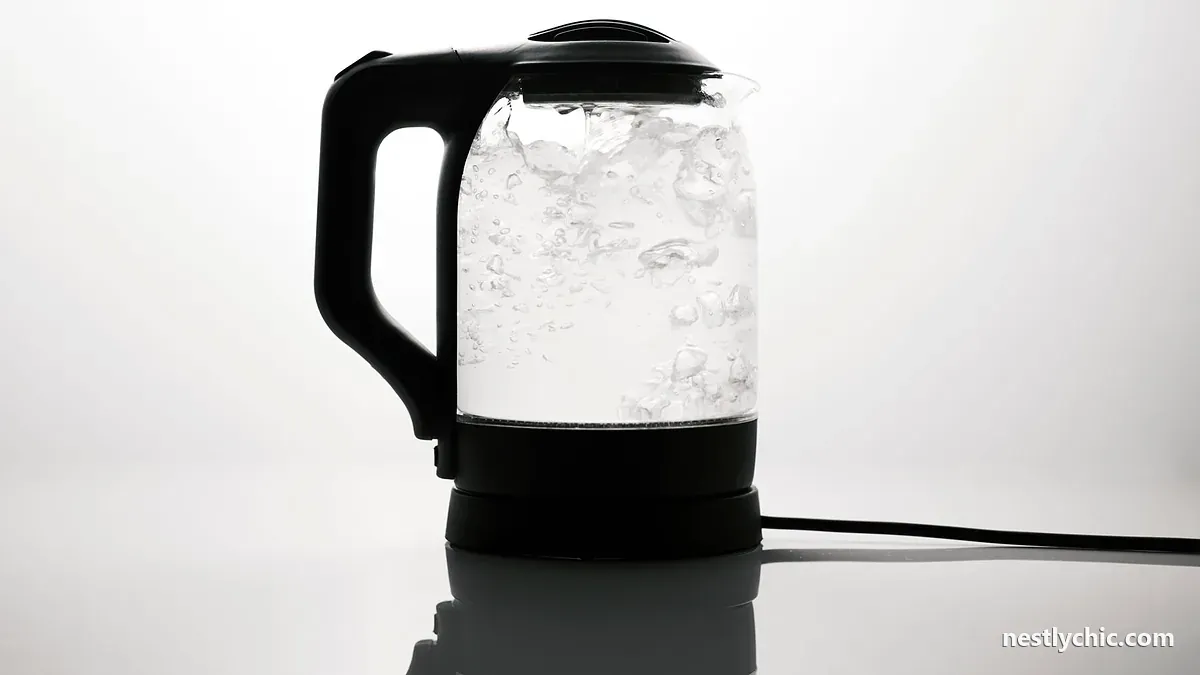
Look inside the kettle. A flat, smooth base means the heating element is concealed underneath it. An exposed metal coil sitting in the water is the older design. A flat base is easier to wipe out and has fewer crevices where mineral scale can collect. Ovente's same page states that its concealed heating element "extends your kettle's life, compared with non-concealed ones that deteriorate faster." That is the maker's own claim, but the reasoning holds: an exposed coil sits directly in mineral-laden water every time you boil.
Automatic shut-off and boil-dry protection
These are two different features, and a kettle should have both.
- Automatic shut-off turns the element off when the water boils.
- Boil-dry protection turns the element off if the kettle is switched on empty or boils down to nothing.
Ovente describes its kettle as one that "shuts off on its own when the pot has reached its boiling temperature and switches off the heating element when there is no water in the kettle." Check the listing or box for both phrases.
One caveat from the same page is worth knowing if you live at elevation. Ovente notes that at higher altitudes its kettle "might not shut off on its own." If you live high up, read the manual's altitude note before you buy, and do not leave a kettle unattended while it heats.
Capacity, cord and base
Capacity is printed in liters on most kettles. Match it to how you use hot water: a household that makes one mug at a time does not need a large kettle, and a household that fills a teapot or a French press does. A cordless kettle that lifts off a base with a center connector is easier to use from either side of the counter. Read the minimum fill line too; it tells you the smallest amount the kettle is designed to heat.
How to choose a toaster
Slot width and length: match the bread you eat
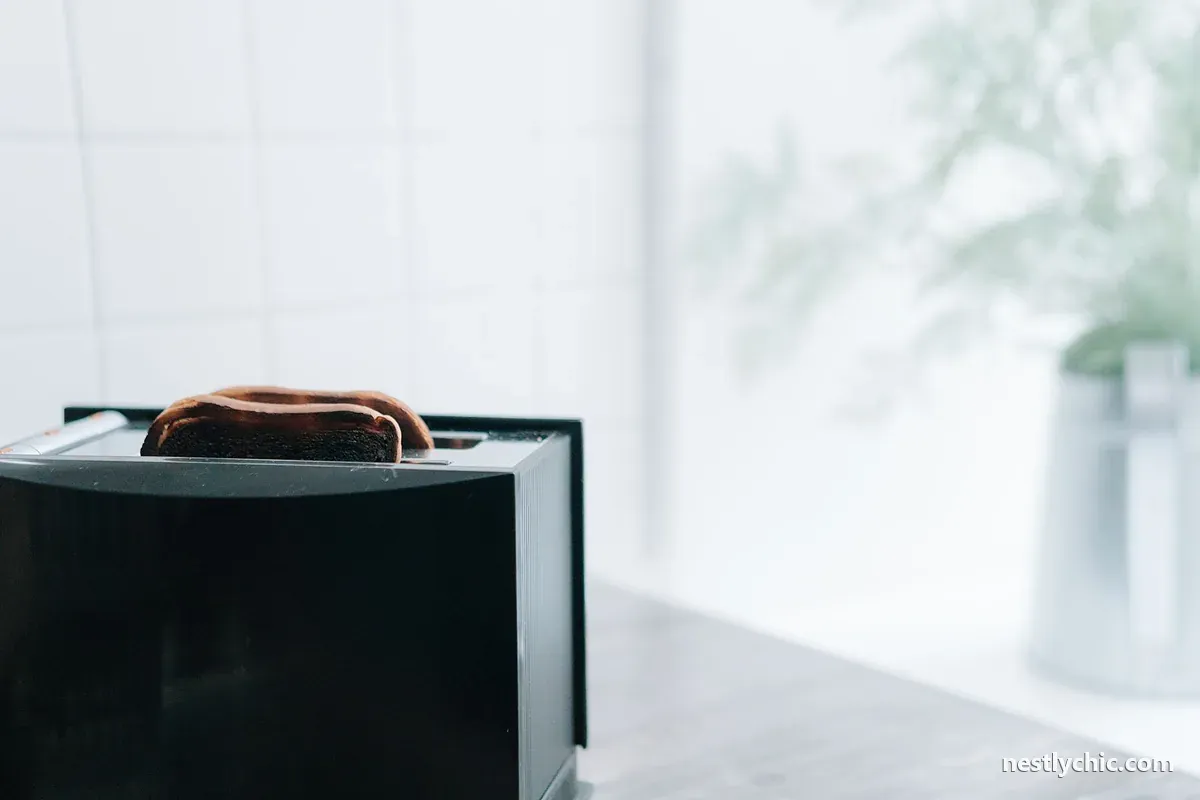
This is the most common toaster regret. Standard slots fit sandwich bread. If you eat bagels, thick-cut or artisan loaves, look for wide slots. If you buy long, oval bread, a long-slot toaster fits one long slice where a standard slot would not. Take a slice of your usual bread to the store, or check the slot dimensions on the maker's spec sheet before buying online.
Two slots or four is a household question. Two works for one or two people who eat at different times. Four suits a household that sits down to breakfast together.
The crumb tray is a safety part
A removable crumb tray is not a convenience extra. Crumbs that collect under the elements can burn. Dualit, a toaster maker, puts it directly in its pop-up toaster safety advice (read September 27, 2026): "A full crumb tray can cause large bread crumbs to get stuck in your toaster and risk catching fire." A tray that slides out from the bottom is the one you will actually empty. You can read Dualit's full pop-up toaster safety advice for the rest.
Controls that earn their place
A shade dial is standard. A cancel button and a lift lever that raises small items higher are genuinely useful. A defrost or reheat setting is useful if you toast from frozen. Beyond that, extra settings are rarely used. The outer housing matters too: metal housings can get hot on the sides, so check for a cool-touch exterior if children are in the kitchen.
Never reach in with metal
Dualit's advice says to avoid inserting knives or other objects into a toaster because of the risk of damage and electric shock, and to "always switch off and unplug your toaster before you clean it." If toast is stuck, unplug it and let it cool first.
Where they live on the counter
Toasters do not belong under cabinets
Dualit's safety advice states that "toasters shouldn't be kept under cupboards or shelves," and that flammable materials such as curtains should be kept away, with nothing stored on top of the unit. It also describes toasters as "attended appliances" that "should not be left in operation without being supervised."
That changes where a toaster fits in a new kitchen. The obvious spot, tucked under the upper cabinets against the backsplash, is exactly where it should not run. Plan a spot with open space above, or pull the toaster forward from under the cabinet each time you use it. Our guide to standard kitchen cabinet dimensions covers how upper cabinets usually sit over the counter.
Two heating appliances, one circuit
Kettles and toasters both draw a lot of power while they heat. Ovente, for example, lists its KP72 kettle at "1100W (120V)." Running a kettle, a toaster and a coffee maker at the same moment on the same kitchen circuit can trip the breaker. If that happens, turn one appliance off and stagger them. If a breaker trips repeatedly, or an outlet feels warm, stop using that outlet and call a licensed electrician; do not open the outlet or the panel yourself.
Cords and damage
Plug both directly into a wall outlet rather than an extension cord unless the manual says otherwise. If a cord is cracked, frayed or scorched, stop using the appliance. A damaged cord on a small appliance is a replace-or-contact-the-maker situation, not a home repair.
Buying them as a matching set
Matching kettle and toaster sets are sold everywhere, and they can be fine. The risk is that a set is chosen for the look, and one half of it is weaker than the other. Check each appliance in the set against the lists above as if you were buying it on its own: concealed element and both shut-off features on the kettle; slot width and a removable crumb tray on the toaster. If one fails the check, buy separately.
If you are tempted by a secondhand pair to save money, our guide to buying kitchen equipment secondhand explains what to check before bringing used equipment home. When you do buy new, register the warranty the same week; our kitchen appliance warranty registration guide covers what to keep.
A two-minute checklist
Kettle
- Interior material you are comfortable with (stainless, glass, or plastic with a stated metal liner)
- Flat base with a concealed element
- Automatic shut-off and boil-dry protection, both stated
- Cool-touch handle
- Capacity and minimum fill line that suit your household
Toaster
- Slots wide and long enough for your usual bread
- Two or four slots, matched to how many eat at once
- Slide-out crumb tray
- Cancel button and a high-lift lever
- A counter spot with nothing above it and nothing flammable beside it
Frequently asked questions
Is a stainless steel or plastic kettle better?
Stainless steel is more durable and will not shatter if dropped, but the outside gets hot. A plastic kettle is lighter; check whether the water sits against plastic or a metal liner. Glass shows the water level and scale but can break. Pick the interior material first, then the look.
What is boil-dry protection on a kettle?
It is a feature that cuts power to the heating element when there is no water in the kettle, for example if it is switched on empty. It is different from automatic shut-off, which turns the kettle off when water boils. A kettle should have both.
Can I keep my toaster under the kitchen cabinets?
Toaster maker Dualit advises that toasters should not be kept under cupboards or shelves, and should be kept away from curtains, with nothing stored on top. If under the cabinets is the only spot, pull it forward into open space before each use.
Should I buy a two-slot or four-slot toaster?
Two slots suit one or two people who eat at different times. Four slots suit a household that eats breakfast together. Slot width matters more than the count if you toast bagels or thick bread.
Why does my kitchen breaker trip when I use the kettle and toaster together?
Both draw a lot of power while heating, and running them at the same time on one circuit can exceed what it is designed to carry. Stagger them. If the breaker keeps tripping or an outlet feels warm, stop using it and have a licensed electrician check it.