Short answer: Switching to induction cookware does not have to mean replacing every pan. The U.S. Department of Energy states that "any pots or pans with a flat bottom that a magnet sticks to will work with an induction cooktop." Bare cast iron, enameled cast iron and carbon steel are made of magnetic iron, and many clad stainless pans pass too. Plain aluminum, copper, glass and ceramic do not, unless a magnetic plate is built into the base. Bakeware is not part of the question at all, because the oven in an induction range is not induction.
The question behind the search is usually "Do I have to replace every pan I own?" The honest answer is that you will not know until you sort what you have, and sorting takes one magnet and one afternoon. What follows is the sorting, piece by piece, then the two checks the magnet test misses, then the order to replace things in.
Why only magnetic pans work
Induction does not heat the glass. The Department of Energy's article on making the switch to induction (dated May 11, 2023, read September 24, 2026) explains that "induction cooking uses an electromagnetic field that transfers currents directly to the cookware," and that "the heat is created from within the cookware itself; as soon as you remove it from a burner, the heating stops."
That is the whole reason some pans work and some do not. The field needs a magnetic metal to act on. Iron and the magnetic grades of stainless steel respond; aluminum, copper, glass and ceramic do not, so the field passes through them and nothing heats. The label on the box matters less than what the base is actually made of, which is why the magnet test works. Our guide to checking whether your cookware is induction compatible walks through the test itself and explains why some stainless steel fails it.
Switching to induction cookware: sort what you own
Go through the stovetop pieces one at a time. The table sorts them by what they are usually made of, but the magnet on your own pan is the final word.
| Piece | Usually made of | Likely result | What to check |
|---|---|---|---|
| Cast iron skillet | Iron | Works | Flat base; lift rather than slide it on glass |
| Enameled cast iron Dutch oven | Iron under enamel | Works | Flat base |
| Carbon steel skillet or flat-bottom wok | Iron alloy | Works | Flat base |
| Clad (tri-ply) stainless pans | Layers; the outer layer decides | Often works | Magnet on the outside of the base |
| Disc-bottom stainless pans | Stainless body, bonded base disc | Often works | How wide the magnetic part of the disc is |
| Aluminum or hard-anodized nonstick | Aluminum | Only with a magnetic base plate | Magnet on the base; look for a steel plate |
| Copper pans | Copper | Usually no | Some have a magnetic base layer; the magnet decides |
| Glass or ceramic stovetop pieces | Glass or ceramic | No | Nothing to check |
| Round-bottom wok | Often carbon steel | Poor contact | A curved base does not sit flat on glass |
| Stovetop kettle or pressure cooker | Varies | Varies | Magnet on the base; the maker's manual |
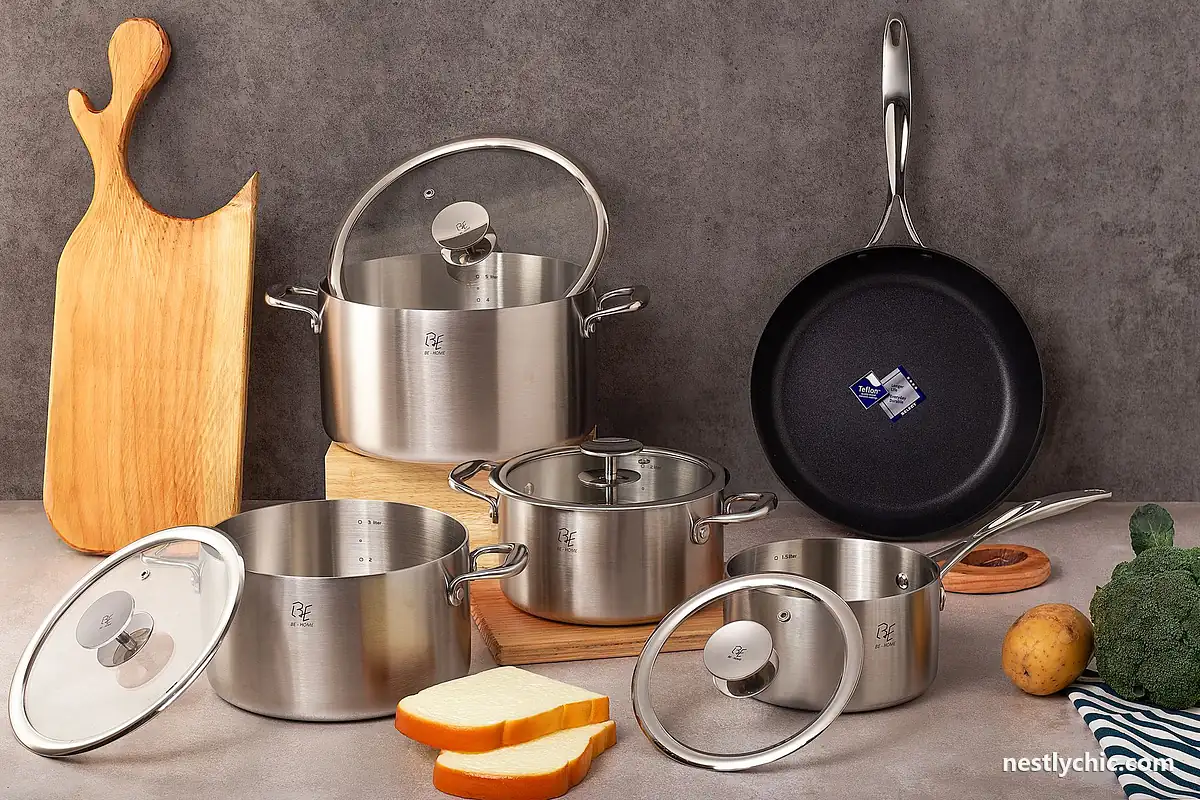
Your pans will split into three piles: pans that pass, pans that fail, and pans that pass the magnet but need a closer look. The third pile is where people get caught out.
Two checks the magnet test misses
A magnet tells you whether the base is magnetic. It does not tell you whether the pan will perform. Two more checks do.
How much of the base is magnetic
GE Appliances' support article on induction cookware size and shape, read September 24, 2026, gives the example of an 11-inch fry pan that may have only 7.25 inches of magnetic material on its base. This can happen with disc-bottom pans and with nonstick pans that have a bonded steel plate: the magnet sticks, but only the magnetic area heats.
The same article says to "match the pan size to the burner size since heating will only occur above the burner's cooking circle," and warns that a pan too small for its burner "will not output its full power to the pan on high." A pan whose magnetic area is much smaller than its rim will heat in the middle and lag at the edges. Our comparison of tri-ply versus disc-bottom construction explains why the two designs behave differently, and the difference shows up clearly on induction.
Every induction zone also has a minimum pan size below which it will not switch on. The use and care manual for your range lists it, zone by zone.
Whether the base sits flat
The Department of Energy's wording specifies "a flat bottom," and GE says the pan should "be centered within the circular graphics marked on the glass cooking surface." A pan that rocks on the counter, or whose base bows up in the middle, makes poor contact with the glass. Put each pan that passed the magnet on a flat countertop and press the rim. If it spins or rocks, it is a candidate for replacement even though it is magnetic.
GE's article also notes that "square pans will work although round pans that match the induction coil sizes work best." A square grill pan will heat, but it may not heat as evenly into the corners.
What about converter disks?
Interface disks, sometimes called converter disks, are flat magnetic plates that sit between the glass and a non-magnetic pan. The disk heats, and the pan sits on it. They are sold as a way to keep aluminum or copper pans in service.
Check your range maker's position before buying one. Wolf's support page on induction interface disks, read September 24, 2026, is unambiguous: "These disks do not work with Wolf Induction Cooktops. Magnetic cookware is always required for use with Wolf Induction products." Other makers set their own terms in their use and care manuals, so read yours rather than assuming. A disk also turns induction back into an indirect method, heating a plate that then heats the pan, which gives up the direct heating that makes induction worth choosing in the first place.
What to replace first
Once the piles are sorted, resist replacing everything at once. Replace in order of use.
- The pan you cook in most days. For many households that is a skillet. If yours failed, replace it first.
- The pot you boil and simmer in. A saucepan or a medium pot covers most of the rest. Our note on the two pans that cover most home cooking explains why these two carry most of the load.
- Anything you use weekly. A stockpot, a sauté pan, a Dutch oven if yours failed.
- Everything else, as you miss it. A pan you have not reached for in a month can wait, and may not need replacing at all.
When you buy replacements, look for the induction symbol, then do the magnet test on the base in the store if you can, and check that the magnetic area covers most of the base rather than a small disc in the middle.
Cooking on induction with the pans you keep
The pans that survive will behave a little differently. Because the pan itself is the heater, it gets hot quickly, and an empty pan or a thin layer of oil can overheat faster than you are used to. That matters most for nonstick coatings, which are vulnerable to overheating. Our guide to what actually ruins a nonstick coating explains the heat problem, and the same care applies with more force on induction.
Heavy pans like cast iron are best lifted rather than slid across the glass, to protect the surface. And none of this changes what goes in the oven: sheet pans, roasting pans, casserole dishes and bakeware all carry on exactly as before.
What this guide cannot tell you
We cannot tell you whether a particular pan will work without the pan in front of you, and we have not tested cookware on induction ourselves. A magnet on the base, a flat countertop and the minimum pan sizes in your range's manual will tell you more than any list. What a cookware maker says about a specific line is worth reading too, since construction varies even within one brand.
FAQ
Do I need all new pans when switching to induction?
Not necessarily. Any flat-bottomed pan a magnet sticks to will work, per the Department of Energy. Cast iron, enameled cast iron, carbon steel and many clad stainless pans usually pass. Replace only what fails, most-used pieces first.
Why does my magnetic pan heat unevenly on induction?
Often because only part of the base is magnetic. GE's example is an 11-inch pan with only 7.25 inches of magnetic material, and heating happens only above the burner's cooking circle. A warped base that does not sit flat makes it worse.
Can I use my aluminum or copper pans on induction?
Not on their own, unless they have a magnetic plate built into the base. Interface disks exist, but some makers, Wolf among them, state they do not work with their cooktops. Check your range's manual first.
Does an induction range change what bakeware I can use?
No. Induction is the cooktop only. The oven in an induction range heats the usual way, so your bakeware is unaffected.