FDA states that foods and drinks may be served on plastic tableware, and separately that foods and drinks should not be heated on melamine-based dinnerware in microwave ovens (FDA, Melamine in Tableware Questions and Answers, read 2026-09-08). That is the distinction the whole subject turns on: serving and heating are not the same act.
FDA also states that when highly acidic foods are heated to extreme temperatures, giving 160 degrees Fahrenheit or higher as its example, the amount of melamine that migrates out of the plastic can increase.
This page reports what the agency publishes. It gives no exposure estimate of its own, clears no specific product, and is not health advice. Questions about your own household are for a clinician or your local health department.
What melamine tableware actually is
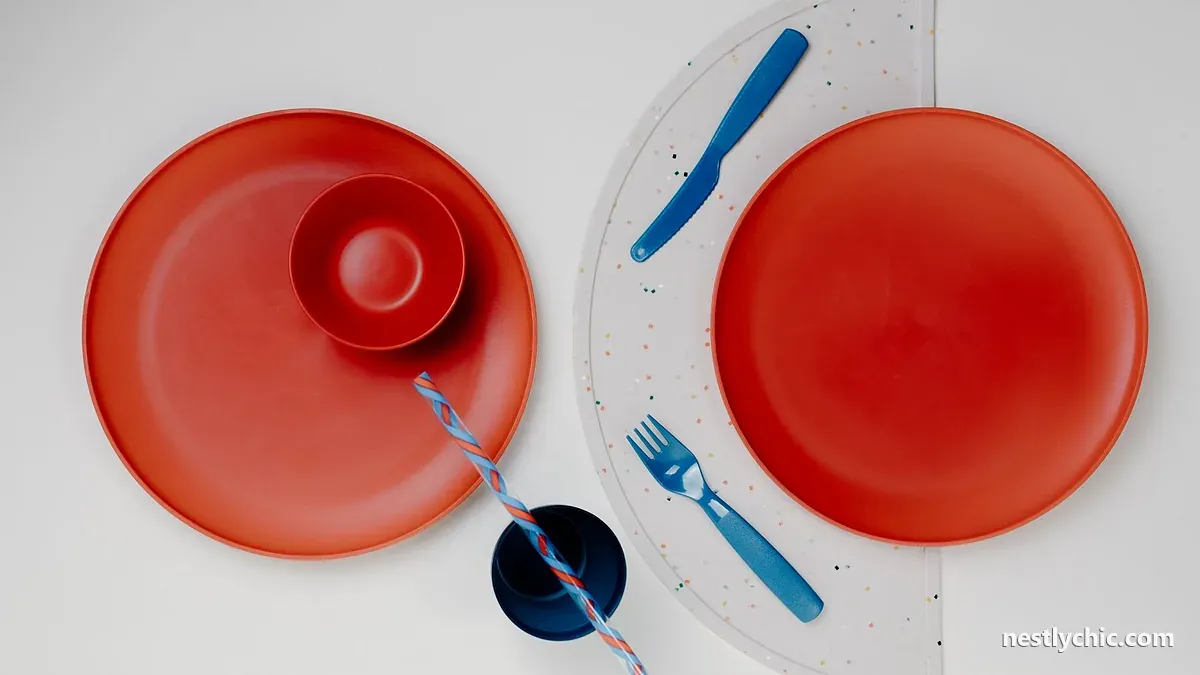
Melamine tableware is a molded plastic made from melamine-formaldehyde resin, not a coating and not a ceramic, although it is often finished to resemble one.
Its use in food-contact articles is authorized by regulation rather than assumed. The Code of Federal Regulations at 21 CFR 177.1460, "Melamine-formaldehyde resins in molded articles," provides that melamine-formaldehyde resins may be safely used as the food-contact surface of molded articles intended for use in producing, manufacturing, packing, processing, preparing, treating, packaging, transporting or holding food. The section defines the resins as those produced when one mole of melamine is reacted with not more than three moles of formaldehyde in water solution, and sets an extractives limit for the finished molded article, tested under the conditions of time and temperature prescribed elsewhere in the regulations (eCFR, 21 CFR 177.1460, read 2026-09-08).
Two things follow from reading the regulation rather than a product page. The authorization is conditional and testable, and the conditions it is tested under are specified in the rule rather than left to the seller. A claim that melamine is "FDA approved" without those conditions is telling you less than the rule does.
Is melamine safe for hot food? What FDA states, in FDA's words
Quoted with the agency's own qualifiers intact, because the qualifiers are the content.
On serving. FDA states: "Foods and drinks may be served on plastic tableware."
On microwaves. FDA states: "Foods and drinks should not be heated on melamine-based dinnerware in microwave ovens. Only ceramic or other cookware which specifies that the cookware is microwave-safe should be used."
On heat and acidity. FDA states: "When highly acidic foods are heated to extreme temperatures (e.g., 160°F or higher), the amount of melamine that migrates out of the plastic can increase."
On the amounts it has assessed. FDA describes migration into acidic foods "under exaggerated conditions," and states that under actual conditions of use migration would be "less than 10 parts of melamine per billion parts of juice," which the agency describes as 250 times lower than the level of melamine it has concluded is acceptable in foods other than infant formula, 2,500 parts per billion.
Read that last paragraph as the agency wrote it. It is a statement about assessed migration under specified conditions, with an explicit carve-out for infant formula, and it sits alongside the instruction not to microwave. It is not a general permission to heat food on melamine, and this page will not summarize it as one.
Where melamine belongs
Stated as fit, not as a recommendation of any product.
Outdoors, and anywhere breakage is likely or dangerous. Patios, poolsides, boats, picnics and camping, where a broken ceramic plate is a hazard rather than an inconvenience.
Where children are carrying their own plates. This is the reason most households own any, and it is a legitimate one.
Buffet and serving use for foods that are already at the temperature they will be eaten at, which is squarely inside FDA's "may be served on plastic tableware."
Where a stack has to be carried a long way, because the weight difference against stoneware is real and is felt by whoever is doing the carrying.
Where it does not belong
Not in a microwave, per the FDA statement quoted above. This is the one line to remember.
Not in an oven or under a broiler. Nothing in FDA's tableware guidance treats melamine as cookware, and the guidance points to cookware that specifies it is microwave-safe for heating.
Not for heating highly acidic food to high temperature, which is FDA's own named condition for increased migration. Tomato-based and citrus-based dishes are the everyday examples.
Not as the plate you reheat leftovers on, which is the single commonest way a household breaks the microwave rule without noticing. If reheating happens on a plate, that plate needs to be one whose maker says it may be. What a microwave-safe or dishwasher-safe mark on a plate does and does not guarantee is a separate question on this site, and the symbols are less informative than most people assume.
And not as a substitute for a considered decision about heat elsewhere in the kitchen. The habit of checking what a manufacturer actually states, rather than what a category is assumed to be, is the same habit that makes sense of the question of whether nonstick cookware is safe and of what a PFAS-free label on cookware really means. Both of those pages take the same approach: the regulator's own words, no minimizing, no alarm.
The practical part FDA's page does not answer
FDA's tableware questions and answers does not give a method for telling whether a piece you already own is melamine. We checked the page for one on 2026-09-08 and it does not provide one. Guides that offer a confident home test for this are going beyond what the agency publishes, and this page will not do that.
What is available to a household instead:
The manufacturer's own marking and documentation, which is where a material name and any microwave or dishwasher statement will be if it exists anywhere.
The retail listing or packaging, if it survives. Melamine is usually marketed as melamine because unbreakability is its selling point.
The maker's care instructions for washing, which vary between products. Dishwasher suitability is a manufacturer statement, not a property of the category, so it has to be read for the specific piece.
And where nothing at all is known about a piece, the honest position is that its material is unidentified, which is a reason to keep it out of a microwave regardless of what it is.
How to decide, in five lines
| Question | Where the answer comes from |
|---|---|
| Will food be heated on it? | FDA: not on melamine-based dinnerware in a microwave |
| Will hot acidic food sit on it? | FDA names heated highly acidic food as the condition where migration can increase |
| Is it going in a dishwasher? | The manufacturer's own care instructions for that product |
| Is breakage the bigger risk here? | Your own setting: outdoors, children, hard floors |
| Do you know what it is made of? | The maker's marking, or nowhere |
Nothing in that table needs a brand name to answer, which is why this page does not supply one.
When to stop using a piece
Melamine is bought because it survives being dropped, which means households keep it far longer than dinnerware they replace on sight. The general signals for retiring kitchen items, including damage, wear and pieces whose origin is unknown, are set out in when kitchen items are actually worth replacing, and they apply here as much as anywhere.
We have found no statement from a named authority about scratched or worn melamine specifically, so this page makes none. Where a manufacturer publishes guidance for its own product, that guidance is the one to follow. And the number of plates a household needs before any of this becomes a daily problem is arithmetic rather than judgement, which is the subject of how many place settings a household actually needs.
FAQ
Is melamine safe for hot food? FDA states that foods and drinks may be served on plastic tableware, and that foods and drinks should not be heated on melamine-based dinnerware in microwave ovens. The agency also states that when highly acidic foods are heated to extreme temperatures, giving 160 degrees Fahrenheit or higher as its example, migration of melamine out of the plastic can increase. Serving and heating are treated differently.
Can melamine plates go in the microwave? FDA's guidance is that foods and drinks should not be heated on melamine-based dinnerware in microwave ovens, and that only ceramic or other cookware specifying that it is microwave-safe should be used.
Is melamine allowed for food contact at all? Yes, under conditions set in regulation. 21 CFR 177.1460 provides that melamine-formaldehyde resins may be safely used as the food-contact surface of molded articles for food use, defines the resin, and sets an extractives limit for the finished article tested under prescribed time and temperature conditions.
Is melamine a good choice for children's plates? It is widely bought for that setting because it resists breaking, which is a real advantage where a broken plate would be a hazard. The heat limits above still apply, including to reheating a child's food. This page recommends no specific product.
How can I tell if a plate I own is melamine? FDA's tableware questions and answers page does not provide a home identification method, and no method is offered here. The manufacturer's markings, packaging or published care information are the available sources. Where the material is unknown, treating the piece as not microwave-safe is the cautious reading.
Sources, read 2026-09-08: U.S. Food and Drug Administration, "Melamine in Tableware Questions and Answers" (fda.gov); eCFR, 21 CFR 177.1460, "Melamine-formaldehyde resins in molded articles" (ecfr.gov). This page states no exposure or dosage estimate of its own, names no product, clears no product, quotes no price, carries no affiliate link and is not health advice. Every safety statement above is attributed to the agency that made it, with its own qualifiers kept intact.