The number of flatware sets a household needs is set by how long the dirty pieces sit before they are washed, not by how many people live there. Two people who run the dishwasher every third day need more forks than four people who wash up after every meal.
So the useful question is not how many settings to buy. It is how many pieces have to be clean and available at the worst moment in your week, which is the last meal before the machine runs. Everything else is arithmetic on that.
How many flatware sets do I need? Start with the wash cycle, not the household
Four numbers decide it, and all four belong to you.
1. People eating at home, on a normal day rather than a busy one.
2. Eating occasions per person per day that use flatware. Count snacks, coffee stirred with a teaspoon and cereal at eleven at night, because those are the occasions that actually empty the drawer.
3. Days between washes. The real interval, not the intended one.
4. Pieces used per occasion, by type. A breakfast uses a teaspoon. A dinner may use a fork and a knife. They deplete at different rates.
Multiply the first three and you have the number of occasions that must be covered between washes. Multiply that by the fourth, per piece type, and you have the drawer you need. The result is not a number of matched sets. It is a different quantity of each piece, which is why boxed sets so often leave a household short of exactly one thing.
We publish no recommended count here on purpose. The count that suits a household is the output of the household's own numbers, and the place-setting arithmetic for the table as a whole lives in one place on this site: how many place settings a household actually needs.
Why the household-size answer is the wrong one
Almost every guide answers this with a number of people. That works only if everybody washes up on the same schedule, and they do not.
A household that runs the dishwasher when it is full is running a buffer, and the buffer is the flatware in the drawer. A longer interval means a bigger buffer.
Hand washing changes it in the other direction. A household that washes after each meal can run remarkably few pieces and never notice.
And a machine that runs half empty for a single missing fork is the visible symptom of an undersized drawer, which is the situation this page exists to prevent.
The pieces that run out first
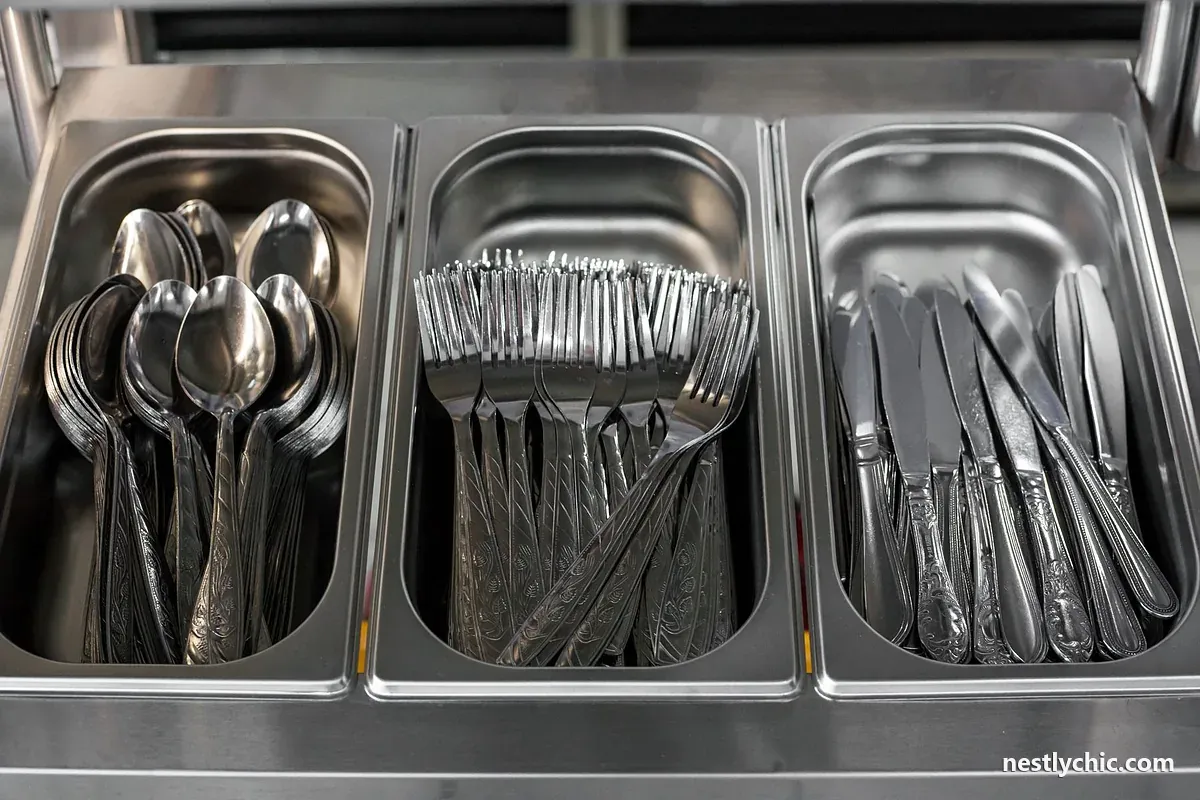
Teaspoons. Used for far more than meals, carried around the house, and lost at a rate no other piece matches. Households that own the same number of teaspoons as dinner forks run out of teaspoons.
Dinner forks. The most-used piece at the most-attended meal.
Knives. Often used less than forks, because plenty of meals do not need one. Households frequently own more knives than they will ever use at once.
Soup and dessert spoons. Highly variable by household. Some use them daily and some own them because they came in the box.
Serving pieces. Not part of the cycle at all, and sized to the largest table rather than to the wash interval.
The practical consequence: the ratios in a boxed set are the maker's assumption about how people eat, and they are frequently wrong about a specific household. The fix is not a bigger box. It is buying more of the two pieces you run out of.
Two ceilings nobody mentions
The dishwasher basket. There is a limit to how many pieces one cycle can wash, and buying past it means the surplus waits for a second cycle regardless of how many you own. Measure the basket, or count what it holds comfortably in a normal load. That number is a real cap on how much buffer is useful.
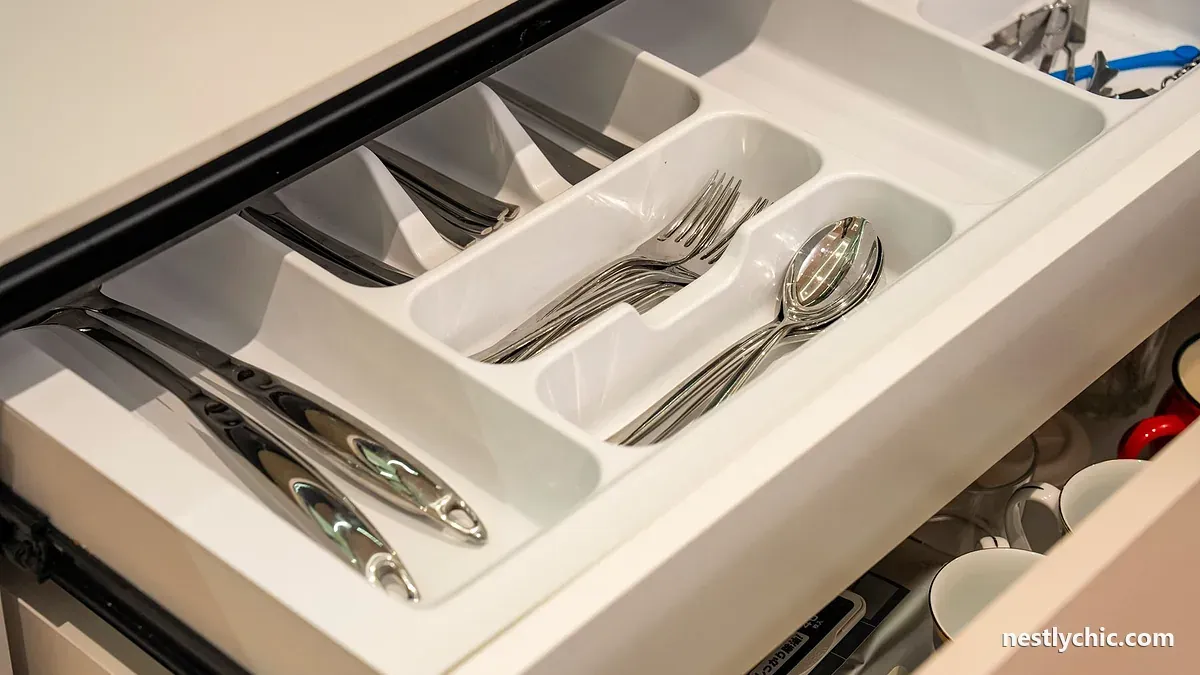
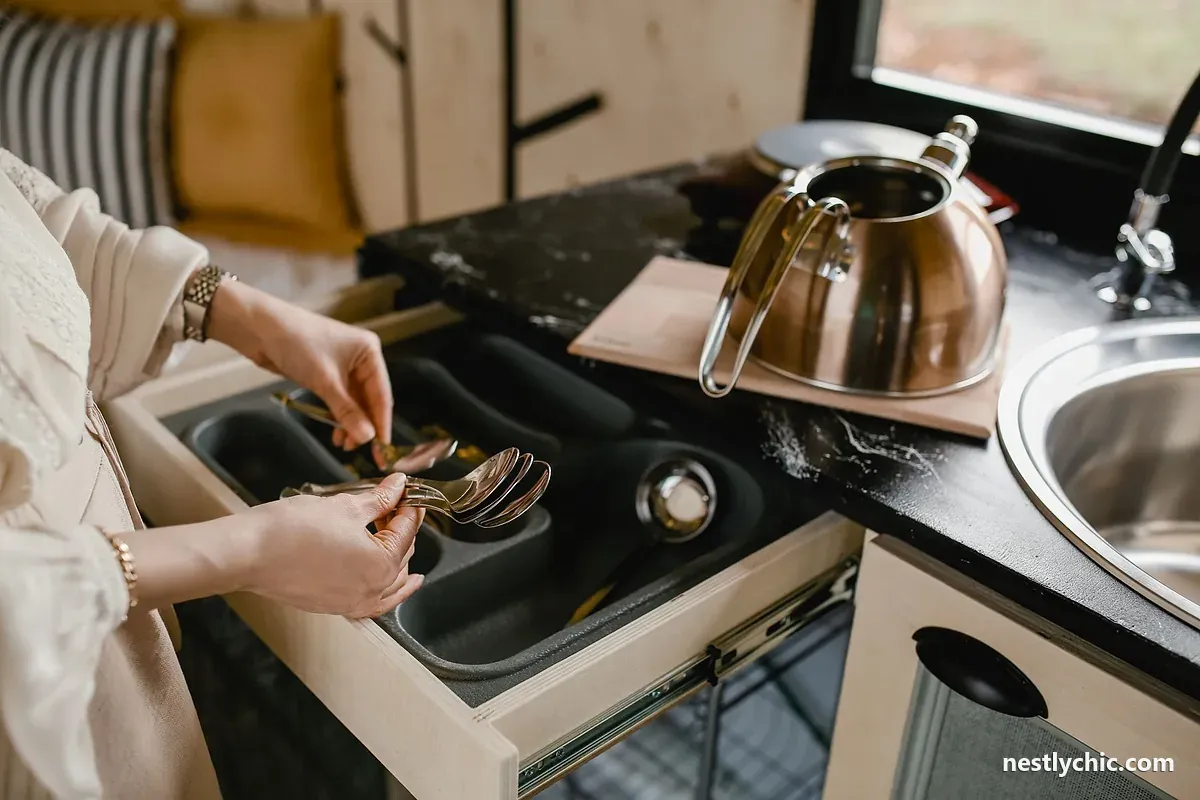
The drawer. Flatware storage is one insert in one drawer in most kitchens, and a set that does not fit the insert ends up loose, which is how pieces get scratched and lost. Both of those constraints are part of the same exercise as matching the kitchen's contents to the size of the household, and they are tighter in a smaller home, which is one of the differences set out in what changes between a house kitchen list and an apartment one.
The hosting question, answered separately
Do not size the daily drawer for the largest dinner you host. That is how a household ends up storing pieces that are used once a year.
Size the drawer for the wash cycle, then decide separately whether hosting needs a top-up. A top-up can be more of the same pattern, a second pattern used deliberately, or nothing at all if the largest table you set is already covered.
And check availability before assuming a top-up is possible later. Flatware is more often sold as individual pieces than dinnerware is, but patterns are still discontinued. Where a warranty is the route back, read what it promises: Lenox publishes a lifetime limited warranty on its applicable fine quality 18/10 stainless steel flatware against defects in material and workmanship for the original owner, with a defective piece repaired or replaced with the same or an equivalent item, and states that minor imperfections such as scratches, stains and discolorations are normal (Lenox warranties page, read 2026-09-08). A warranty replaces a defective piece. It does not restock a drawer.
If you are adding to a set you already own
Match the family, not just the look. The British Stainless Steel Association's article on cutlery grades sets out that 18/8 and 18/10 describe the same nickel-bearing steel, known as 304, while 18/0 contains no nickel and belongs to a different family used where corrosion resistance is less demanding (British Stainless Steel Association, cutlery stainless steel grades, read 2026-09-08). Pieces from different families sharing a dishwasher may not age at the same rate, which is how a drawer ends up looking mismatched even when the patterns match.
Buy the pieces you run out of, not another balanced set. This is the single cheapest correction available and almost nobody makes it.
And note what you actually reach for. A household that has quietly standardized on one fork out of the three it owns has already told you what to buy more of.
Setting the number for a new kitchen
If there is nothing in the drawer yet, the wash interval is still the input, but it has to be estimated rather than observed. Estimate long rather than short: a household that overestimates how often it will wash up ends up short in the first month.
Then treat the first three months as data. If the drawer empties before the machine runs, the number was low. If pieces sit unused at the back, it was high. This is the same approach as the rest of the first-kitchen list in the new home kitchen checklist, where the useful move is buying what the routine demands rather than what a complete list assumes.
One thing worth doing on day one: count what came with the house, what was inherited and what is already in a box, before buying anything at all. Mismatched flatware works perfectly well as a buffer even in a household that wants a matched drawer for guests.
FAQ
How many flatware sets do I need? The number depends on how many eating occasions happen between washes, which is people, occasions per person per day and days between washes, multiplied by the pieces each occasion uses. A household that runs the dishwasher twice a week needs a bigger buffer than one that washes daily, at the same household size.
Does running the dishwasher less often mean I need more flatware? Yes. The clean flatware in the drawer is the buffer that covers the interval, so a longer interval requires more pieces. A dishwasher that runs half empty because one fork is missing is the usual sign the buffer is too small.
Do I need the same number of every piece? Usually not. Teaspoons and dinner forks tend to deplete fastest, and knives are often owned in larger numbers than a household ever uses at once. Boxed sets supply equal counts, which is why households end up short of one piece and long on another.
Should I buy extra flatware for guests? Size the daily drawer to the wash cycle first, then decide about hosting separately. Buying one large set to cover both usually means storing pieces that are used once or twice a year.
Can I add to a set later? Often, if the pattern is still sold individually, and flatware is more commonly available that way than dinnerware. Patterns are still discontinued, so it is worth checking before relying on it. When adding pieces, matching the steel family as well as the pattern helps the drawer age evenly.
Sources, read 2026-09-08: Lenox warranties page (lenox.com); British Stainless Steel Association, cutlery stainless steel grades. This page publishes no recommended piece count, because the count is the output of a household's own wash interval and the place-setting arithmetic for this site lives on the place settings page. No product is ranked or recommended, no price is quoted and no affiliate link appears. Nothing here was tested or owned by this site.