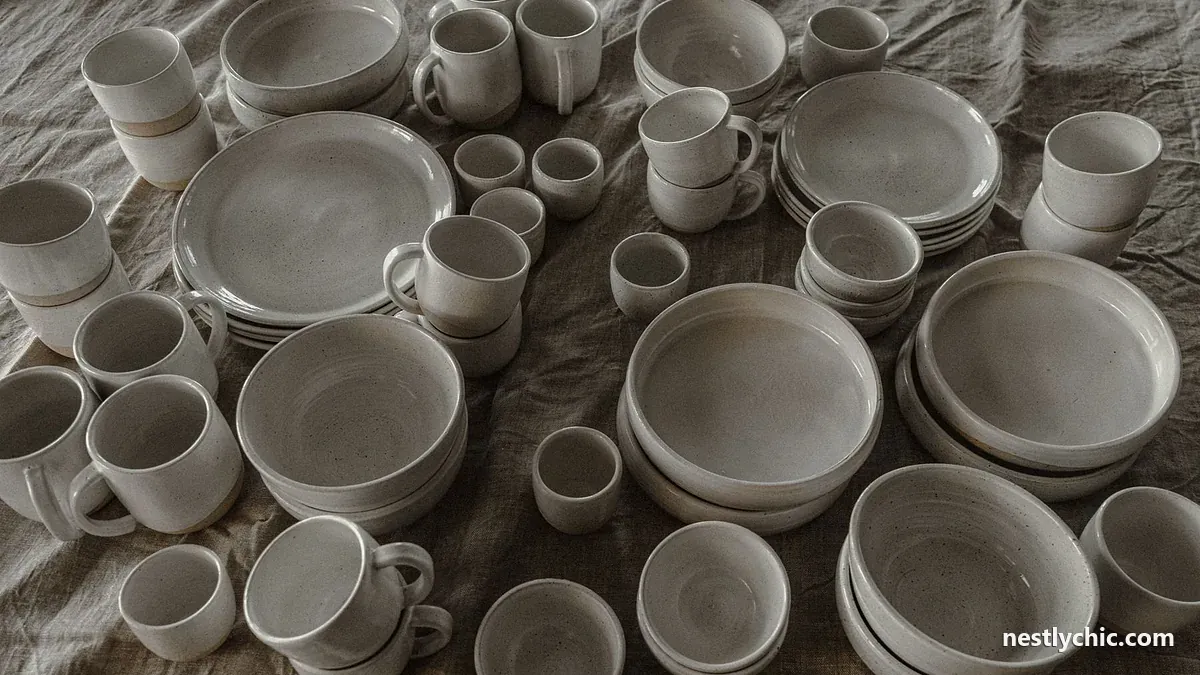
Buying a boxed set is buying a fixed group of pieces at one time. Buying open stock is buying pieces individually from a pattern the maker is currently selling that way. The difference people expect is price and flexibility. The difference that actually costs them is replacement: open stock is a current availability status, not a guarantee that the pattern will still be sold in five years.
So the question is not which is better. It is how much you are willing to lose when the first plate breaks, and that has a different answer for a household that will break plates than for one that will not.
Open stock vs set: what each word actually promises
A boxed set promises a coordinated table on the day it arrives. Four or six or eight of each piece, chosen by the maker, at a single price. What it does not promise is anything about the sixth year.
Open stock promises that today, individual pieces of that pattern can be bought on their own. That is genuinely useful. It lets a household buy eight dinner plates and two mugs instead of eight of each, which is closer to how most people actually eat.
Neither promise extends forward in time, and the makers say so in their own words. Corelle's published FAQ states that although the company tries to create dinnerware designs with lasting appeal, some patterns lose their popularity over time, and when that happens the pattern is discontinued (Corelle FAQ, read 2026-09-08). The same FAQ then points customers at a third-party specialist, Replacements, Ltd., for pieces from patterns the company no longer carries.
That is the honest shape of the market. A maker sells a pattern while it sells, and a secondary market exists precisely because patterns stop.
The four questions that actually decide it
Not a verdict. A sequence, and the answers are yours.
1. How likely is breakage in this household, honestly? Small children, a hard floor, a crowded sink and a habit of stacking wet plates all raise it. If breakage is likely, the replaceability of a single piece matters more than the coordination of the original purchase.
2. Do you want the pieces the set contains? A 16-piece set is four of each of four pieces. If your household will never use a saucer, you are storing four saucers forever. Open stock lets you skip them. This is the same reasoning we set out for pans in buying a cookware set against buying individual pieces, and dinnerware is the sharper version of it because the piece count is higher.
3. How many do you need in the first place? The replacement question only matters relative to the number in the cupboard. A household running twelve dinner plates loses less to one breakage than a household running four, and the arithmetic behind that number is in how many place settings a household actually needs.
4. Can you tolerate a mismatch? This is the question people answer last and should answer first, because a household that is genuinely comfortable with two patterns on one table has no replacement problem at all.

What the makers' own documents say about getting a piece back
This is the part the buying guides skip, and it is all published.
Warranties are not the same as availability. A warranty is a claim you make against a defect. Availability is whether the pattern is still for sale. They fail independently, and a pattern can be discontinued while the warranty is still live.
Corelle Brands publishes a limited three-year warranty on Vitrelle glass dinnerware against cracking, breaking or chipping from the date of purchase, and states that it applies to products damaged during normal household use and does not cover damage from misuse, negligence, accidental breakage or attempted repair (Corelle product warranties page, read 2026-09-08). The company also states that where an exact match is not available, comparable items are supplied.
The Fiesta Tableware Company warrants all first-quality dinnerware against chipping under normal usage conditions for five years from delivery, and will replace pieces found to be defective with identical or equivalent pieces on a one-for-one basis. Its published warranty expressly excludes all breakage and chipping caused by drops, falls or knocking against something (Fiesta Factory Direct warranty page, read 2026-09-08).
Lenox publishes a replacement promise under which a defective dinnerware or serveware item, or one that breaks during normal use, is replaced free, subject to the item having been registered and proof of breakage being shown, for the original owner only (Lenox warranties page, read 2026-09-08).
Read those three together and a pattern appears. Every one of them replaces a piece that failed as a product. None of them replaces the plate you dropped. The way plates actually break in a household is almost always the excluded way, which is why availability, not warranty, is the thing to check before buying.
| What you are checking | Where it is published | What it does not cover |
|---|---|---|
| Is the pattern sold as open stock now | The maker's or retailer's current listing | Whether it will be next year |
| Manufacturing defect cover | The maker's warranty page | Drops, knocks and accidental breakage, stated explicitly by Fiesta and Corelle |
| Replacement with an exact match | The warranty's own wording | Corelle states comparable items where no exact match exists; Fiesta states identical or equivalent |
| Registration requirements | The maker's terms | Lenox conditions its replacement promise on prior registration |
None of that is a reason to avoid any of them. It is the reason to make the availability decision consciously rather than assuming a set is a permanent supply line.
The information nobody puts on the box
A pattern's shelf life is a commercial decision, not a product property. Nothing about the plate tells you how long it will be made. The only signals a buyer can read are how long the pattern has already been in production, whether the maker sells it as open stock today, and whether a secondary market for that maker exists at all. Corelle's own FAQ pointing at Replacements, Ltd. is evidence that one does for that brand.
Plain white in a common shape is the least fragile bet, not because the plates are stronger, but because a plain plate in a standard shape is the easiest thing in the category to approximate later. A distinctive decorated pattern is the hardest.
Buying more of one piece up front is the cheap insurance, and it is what open stock is genuinely good for. Two spare dinner plates bought with the original purchase cost less trouble than one hunted down after a discontinuation.
A set with an odd count is not a defect. If a boxed set is the right buy, the household is allowed to add two open-stock dinner plates to it on day one and never think about it again.
Where each approach genuinely fits
Stated as fits, not as picks, because nobody here has used your pattern and cannot tell you what to buy.
A boxed set fits a first kitchen that needs a working table quickly, a household where breakage is unlikely, and a buyer who is comfortable replacing the whole set eventually rather than piece by piece.
Open stock fits a household with children, a household that wants an uneven piece mix, and anyone who intends this to be the last dinnerware decision for a long time.
A deliberate mix fits more people than admit it: a plain open-stock core for daily use, and a smaller number of anything you like on top. The core is what has to be replaceable. The rest can be whatever survives.
And there is a third option that costs nothing: decide in advance what happens when a piece breaks. A household that has already agreed it will run seven plates rather than eight is not having a problem. It is having a plate fewer.
Before you buy, four things to check
The current listing, to confirm the pattern is genuinely sold as individual pieces and not only in a box.
The maker's warranty page, for what it covers and what it excludes, in the maker's own words rather than a retailer's summary.
Whether a secondary market exists for that brand, which for some makers is stated in their own FAQ.
Your own tolerance for a mismatch, which decides how much any of the above is worth. Checking these once is the same discipline as auditing what you already own before buying anything else, and it is cheaper than any of the alternatives.
One more, if the set you are replacing is old: the reason a piece failed matters. A plate that chipped from a knock is a different situation from a set that has been quietly degrading, and the general signals are in when kitchen items are actually worth replacing.
FAQ
What does open stock mean for dinnerware? It means the maker currently sells individual pieces of that pattern separately rather than only in a boxed set. It describes what is available now. It is not a commitment that the pattern will continue to be made.
Is it cheaper to buy a dinnerware set or open stock? A boxed set is usually the lower cost per piece at the moment of purchase, because it is sold as a bundle. Open stock can cost less overall when it lets you skip pieces you will never use. Which is cheaper depends on how many pieces you would otherwise be storing unused, so no general answer holds.
Can I replace one broken plate from a set? Sometimes, and it depends on whether the pattern is still in production and sold individually. Where it is not, makers may point to a specialist in discontinued patterns: Corelle's own FAQ refers customers to Replacements, Ltd. Warranties are a separate route and generally cover defects rather than breakage you caused.
Does a dinnerware warranty cover a dropped plate? Generally not, and the published wording says so plainly. The Fiesta Tableware Company's warranty expressly excludes all breakage and chipping caused by drops, falls or knocking against something, and Corelle's excludes accidental breakage. Read the specific warranty for the pattern you are buying.
What if my pattern is already discontinued? The secondary market for discontinued tableware exists and some makers name it themselves. Beyond that, the realistic options are running a smaller count, accepting a deliberate mismatch, or replacing the core of the set and keeping the surviving pieces for lighter use.
Sources, read 2026-09-08: Corelle FAQ and Corelle product warranties, safety and usage pages (corelle.com); The Fiesta Tableware Company warranty (fiestafactorydirect.com); Lenox warranties page (lenox.com). This page names no product as a recommendation, ranks nothing, quotes no price and carries no affiliate link. Brands are named only where a statement is taken from that company's own published document.