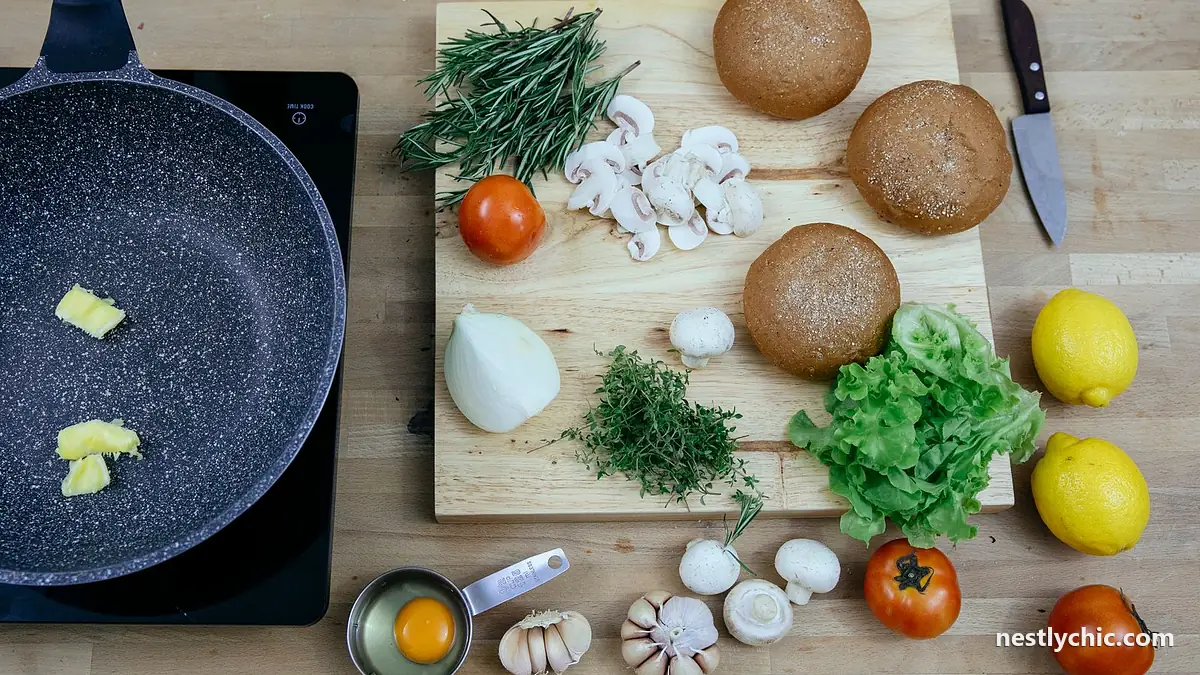
The fastest way to keep a first kitchen affordable isn't picking a price tier, it's shrinking the list. A household can cook nearly any real stovetop meal with one skillet, one saucepan, one general-purpose knife, one cutting board, a set of mixing bowls and basic utensils, and a small set of storage containers. Everything past that core list is genuinely useful eventually, but not required to start cooking, and most "kitchen essentials" checklists bundle it in anyway, which is what actually inflates the budget. The cheapest way to outfit a kitchen is to buy the core list well, then add only when a real gap shows up in real cooking.
Most "kitchen essentials on a budget" guides answer a different question than the one in the search bar. They give a flat inventory (47 items, 58 items, 60 items) with a dollar figure attached, as if the budget problem is purely about finding the item at the lowest price. That treats the list itself as fixed and only the price as negotiable. The list is not fixed. A large share of what's on a typical "must-have" checklist duplicates a function the core list already covers, or solves a problem a new household hasn't actually run into yet.
The Core List: What It Actually Takes to Cook a Real Meal
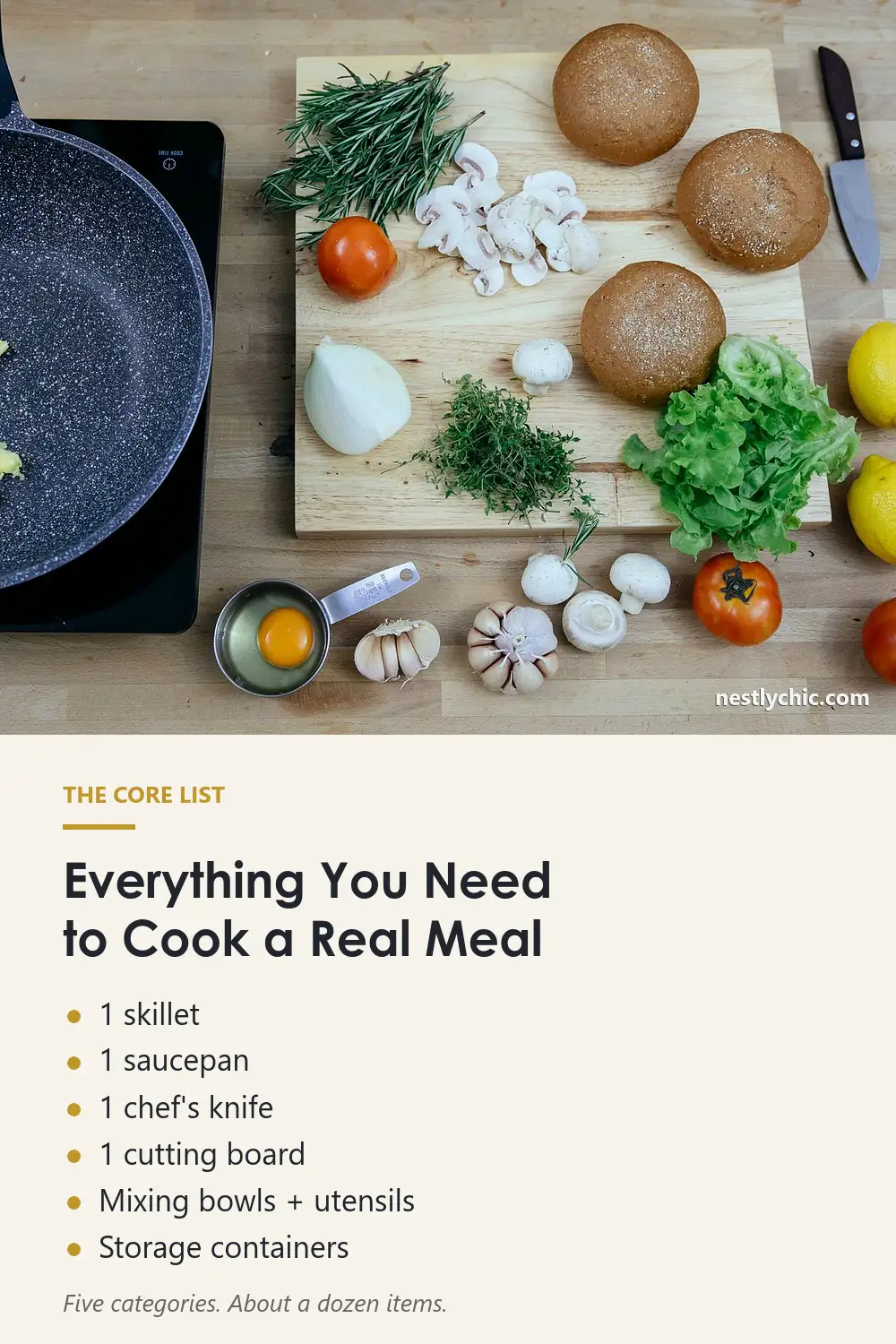
This is the complete list of categories needed to cook a genuine stovetop and oven-adjacent meal from a bare kitchen, not a suggestion to buy every popular gadget in each category:
| Category | What's actually needed | What it covers |
|---|---|---|
| Cookware | One skillet (10 or 12 inch), one saucepan with a lid | Searing, frying, sautéing, sauces, grains, reheating |
| Cutting | One chef's knife, one cutting board | Nearly all prep work |
| Mixing and measuring | A small mixing bowl set, one set of measuring cups and spoons | Baking, sauces, marinades, batter |
| Utensils | A spatula, a wooden or silicone spoon, tongs | Stovetop cooking and serving |
| Storage | A small set of stackable containers | Leftovers and fridge storage |
Five categories, roughly a dozen individual items. That's the entire list required to cook consistently. Everything else on a typical checklist is an addition, not a requirement.
See the two pans that cover most home cooking for the reasoning behind why one skillet and one saucepan, specifically, do the work most lists spread across five or six cookware pieces.
Why This List Is Shorter Than Most "Kitchen Essentials" Checklists
Checklists that run to 50 or 60 items tend to pad the count in three predictable ways: they list specialty tools with a single narrow use (an avocado slicer, a garlic press, an egg separator) that a knife or a fork already handles adequately; they list multiple sizes or quantities of the same tool (three cutting boards, four mixing bowls) before the household knows how many it actually needs; and they list small appliances (a toaster, a coffee maker, a blender) as if every household needs every one on day one, regardless of what that household actually eats and drinks.
None of that is wrong to eventually own. It's wrong to treat as required before a single meal has been cooked in the new kitchen.
What to Defer, and Why Deferring It Doesn't Cost You a Meal
A few categories worth holding off on, with the reasoning for each:
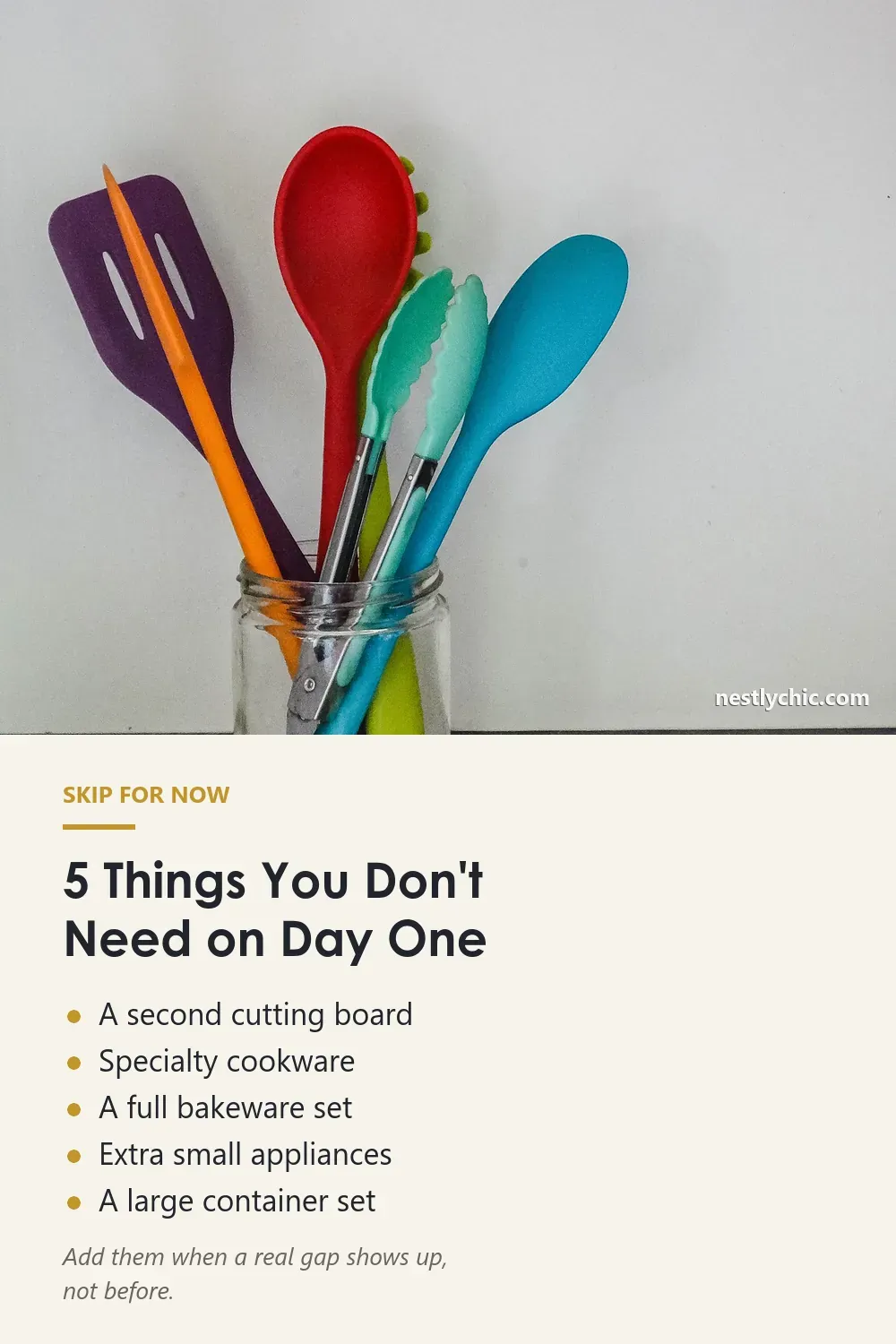
- A second cutting board. One board handles produce, protein, and everything else in sequence. A second board is a convenience once the household knows its actual prep rhythm, not a requirement to start.
- Specialty cookware (a wok, a griddle, a dedicated omelet pan). Each solves a narrower version of a job the skillet already does. Add one once a specific dish becomes a regular part of the household's cooking, not before.
- A full bakeware set. One sheet pan covers most early oven cooking. A full set of cake pans, muffin tins, and casserole dishes can wait until baking is actually happening regularly.
- Small appliances beyond what's used daily. A toaster or coffee maker used every morning earns an early place on the list. A stand mixer, waffle iron, or specialty appliance doesn't, until a specific, repeated need shows up. See what to skip until you know how you actually cook for the fuller list of what tends to sit unused.
- A large storage container set. A small starter set handles the first weeks of leftovers. Buying a full pantry-sized system before the household knows its own storage habits usually means buying the wrong mix of sizes.
The Two Things Worth Getting Right Even on a Tight Budget
A short list doesn't mean every item on it should be the cheapest available version. Two categories are worth spending attention (not necessarily money) on, because a poor version actively makes cooking harder rather than just being a lower-quality version of the same experience:
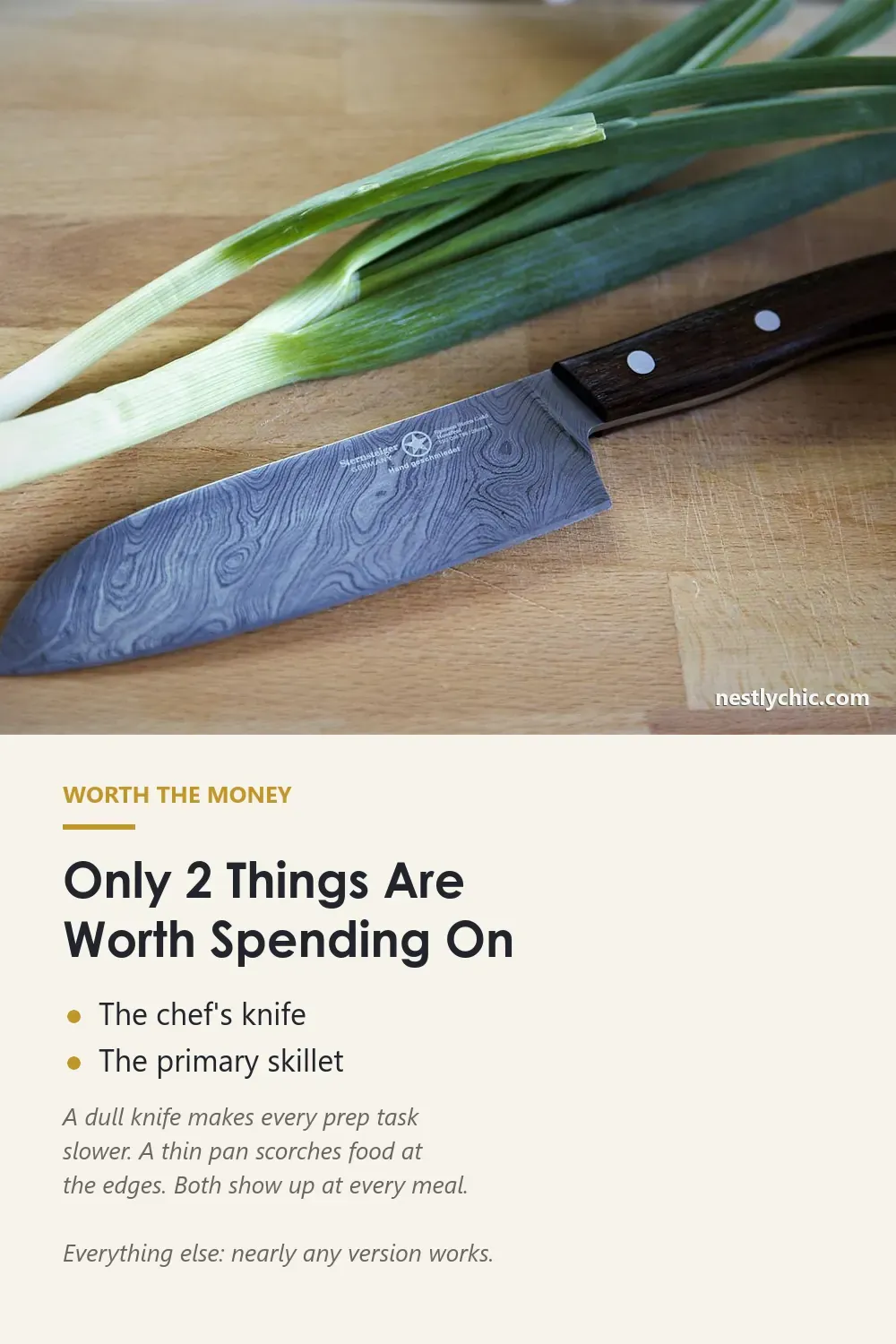
- The chef's knife. A dull, poorly balanced knife makes every single prep task slower and less safe, and it gets used at nearly every meal. This is the one item on the core list worth researching rather than grabbing at random.
- The primary skillet. A pan with an uneven or very thin base scorches food near the edges and heats unpredictably, which shows up in results at every meal it's used for. Material and construction quality matter here more than in almost any other core-list category.
Neither of these is a call to buy the most expensive version available. It's a call to not treat these two the same way as, say, a mixing bowl, where nearly any version does the job equally well. For a fuller breakdown of which categories reward spending attention and which genuinely don't, see where to spend and where to save in a first kitchen.
When to Add Beyond the Core List
The signal to add something isn't a moving-in date or a arbitrary timeline, it's a repeated, specific frustration with the core list. A household that keeps reaching for a second pan because the first is still dirty from the last step of a recipe has a real signal to add a second skillet or saucepan. A household that keeps improvising a job the core list doesn't cover well (whisking a large batch of egg whites, say) has a real signal to add the specific tool for that job. Buying reactively, once an actual gap shows up, tends to produce a kitchen full of things that get used. Buying an entire checklist upfront tends to produce a kitchen full of things that don't. See the three-month buying timeline for a phased approach that spreads additions out instead of front-loading them.
If You Want Actual Price Ranges Instead
This piece is deliberately scoped to what's needed, not to what any of it costs, because prices move constantly and a number printed here would be stale within weeks. For readers who want three concrete price-tier builds with current ranges attached, see kitchen essentials by budget, which prices a starter, comfortable, and buy-once build from live retailer listings.
FAQ
What's the single biggest way to save money on a first kitchen? Buying fewer items, not cheaper versions of more items. Most of the savings available come from not buying specialty tools and duplicate pieces the core list doesn't need, rather than from finding a lower price on everything on a 60-item checklist.
Is it a mistake to buy a cookware set to save money on a budget? Not automatically, but a set sized for cooking habits the household doesn't have yet often ends up more expensive than buying the core list piece by piece. See cookware sets versus individual pieces for that decision in full.
Do I need small appliances on day one? Only the ones used daily. A toaster or coffee maker used every morning earns an early spot; most other small appliances are better added once a specific, repeated need is clear.
How do I know if I'm skipping something I'll actually regret not having? Watch for repeated frustration, not a single inconvenient moment. If the same gap shows up two or three times in real cooking, it's a genuine signal to add the specific tool for that job, not the whole category around it.
Should I buy the core list all at once or spread it out? Either works, but spreading it out across the first few months lets real cooking habits inform what gets added beyond the core list, rather than guessing everything upfront. See the three-month buying timeline for a phased order.