Four names, one shelf, and no explanation anywhere on the packaging. The useful way in is not to memorize four definitions but to understand the one property they are all describing, which is how much water the fired clay body can absorb.
That property has a name, vitrification, and it is what firing temperature produces. A body fired hot enough becomes glassy and absorbs almost nothing. A body fired cooler stays porous, and the glaze is doing the sealing rather than the body.
Everything people care about follows from that: chip resistance, staining, whether it survives a dishwasher over years, and whether a crack in the glaze is cosmetic or not.
The four, arranged by that one property
Earthenware. Fired at the lowest temperatures and the most porous of the four. The glaze is doing most of the work of keeping water out, which is why a chip in the glaze on earthenware matters more than a chip on porcelain. Typically thicker, often the rustic-looking pieces.
Stoneware. Fired hotter, denser than earthenware, and the usual everyday choice. Robust, heavier than porcelain, and generally the middle of the range on every axis.
Porcelain. Fired hottest, the most vitrified, and consequently the least porous. Thin walls are possible because the body itself is strong, which is why porcelain can look delicate and be tough.
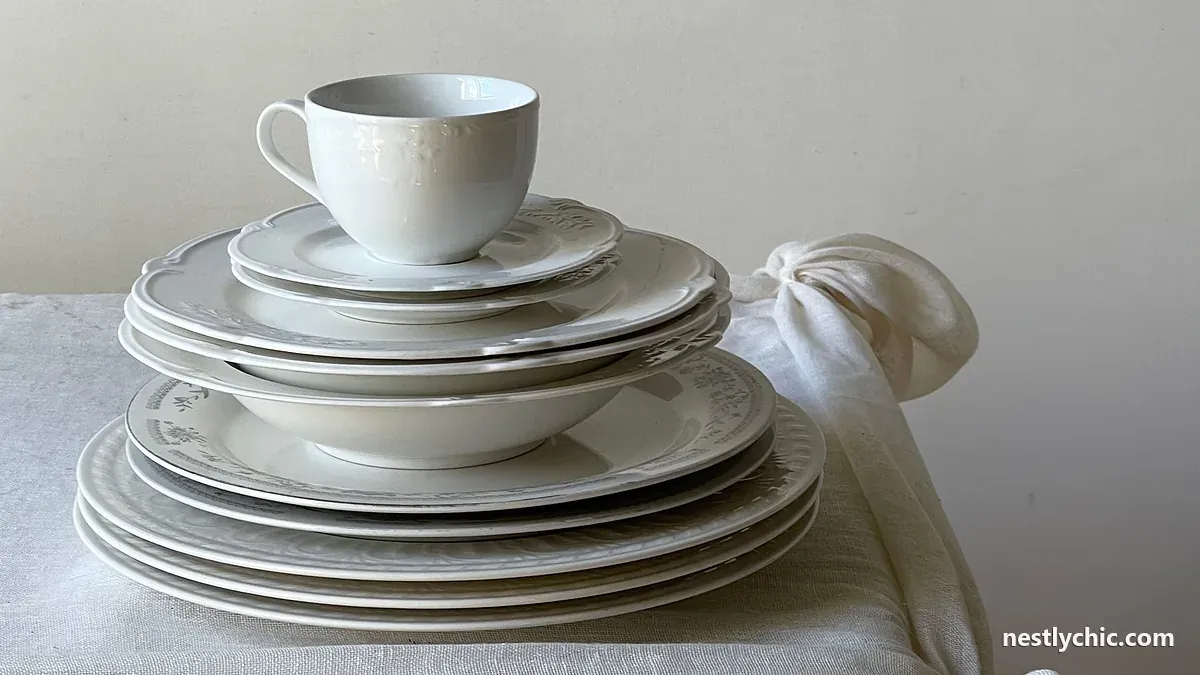
Bone china. A porcelain-type body with bone ash in the recipe. Very white, translucent when held to light, and typically the thinnest and lightest of the four.
Notice what that ordering does. It puts "thin and delicate looking" and "durable" on the same end, which is the opposite of what most people assume when they pick up a piece.
The word that has no fixed meaning
"Vitrified" and its cousins are used as marketing terms as well as technical ones, and the label on a plate is not a certification.
What you can do about that: ask what the maker states rather than what the category name implies. Some manufacturers publish body type, firing information and warranty terms; many do not.
And treat the descriptive words with suspicion in both directions. "Fine china," "hotel grade," "restaurant quality" and "ultra-durable" are marketing phrases rather than defined categories, and there is no body that certifies any of them for dinnerware.
That is the same discipline this site applies to cookware coating claims, where the finding is that a label without a defining authority behind it is a description rather than a guarantee. The worked example is in PFAS-free, PTFE-free and ceramic: what the labels mean.
What actually changes in a household
Weight. Stoneware and earthenware are heavier for the same shape. That matters for a full shelf, for a child carrying a plate, and for anyone with grip or wrist limitations.
Chip behavior. All four chip. What differs is what a chip exposes: on a porous body, a chip through the glaze exposes material that can absorb water.
Crazing. The fine network of cracks that appears in a glaze over time, more common on lower-fired bodies. Whether it is purely cosmetic depends on what is underneath it, which is the porosity question again.
Staining. Porous bodies and crazed glazes hold stains in a way vitrified bodies do not.
Thermal behavior. Any ceramic can fail from thermal shock, and the limits are manufacturer-specific rather than category-wide. This site treats every thermal limit as a per-product figure, which is why the terminal page for it is glass, ceramic and stoneware bakeware: thermal shock and what cracks and no general figure appears here.
The question this page does not answer
Whether a specific piece is safe to eat off.
Glaze composition is a separate subject from body type, and it is the one with a genuine safety dimension: lead and cadmium in glazes, decorative and imported ceramics, and what "lead free" on a label does and does not mean. None of that is decided by whether a piece is stoneware or porcelain, and this page makes no statement about it.
That is its own page on this site, with FDA sourcing, and it is where every glaze and food-contact-ceramic statement belongs.
The symbols on the bottom
Dishwasher, microwave and oven marks are the other thing people read off the underside, and they guarantee narrower things than most readers assume. That is also its own subject rather than a line here.
How to actually choose
Ignore the four names for a moment and answer these.
| Question | What it points at |
|---|---|
| Who carries the plates, and how heavy is a full stack | Weight, which separates stoneware from porcelain more than durability does |
| Will these go in a dishwasher daily for years | Density and glaze quality, and what the maker warrants |
| Do you mind visible crazing developing | Lower-fired bodies craze more readily |
| Do you want to see the food or the plate | An aesthetic question that is genuinely yours |
| Is the pattern available as open stock | Decides what happens when one breaks, and it matters more than the material |
| Will the diameter fit the shelf | Measure first; see the cabinet, drawer and counter dimensions that decide what fits |
The open stock row is the one that saves money over a decade, and it has nothing to do with which of the four words is on the box.
FAQ
What is the difference between stoneware and porcelain? Firing temperature and the density that results. Porcelain is fired hotter and is the more vitrified, meaning less porous. Stoneware is denser than earthenware and typically heavier than porcelain for the same shape.
Is bone china stronger or weaker than porcelain? Bone china is a porcelain-type body with bone ash in the recipe, and it is typically thinner and lighter. Thin does not mean fragile in this category, which is the assumption most people bring to it.
What does vitrified mean? That the fired body has become glassy enough to absorb very little water. It is the property the four category names are all describing indirectly, and it is also used as a marketing word, so the label alone is not a specification.
Is earthenware bad? It is the most porous of the four, which means the glaze is doing more of the sealing work, so a chip through the glaze matters more. Whether that is a problem depends on how the pieces are used.
Which is most chip resistant? All four chip, and durability claims on dinnerware are not certified by any body we could cite, so this page names no winner. What differs is what a chip exposes underneath.
Does the material decide whether it is safe to eat off? No. Glaze composition is a separate subject from body type, and lead and cadmium in glazes is its own question with its own sourcing on this site.
Sources: this page quotes no firing temperature, porosity figure, price or lifespan figure, and cites none, because the category names are conventions rather than standards and no body certifies durability claims for domestic dinnerware. Thermal limits are treated as manufacturer-specific and are routed to this site's glass, ceramic and stoneware bakeware page. Glaze safety, including lead and cadmium, is a separate subject on this site with its own FDA sourcing and is not addressed here. No brand or pattern is named or recommended.