There is one published figure that settles most of this and it is not a length or a width. It is a depth, and it comes from USDA.
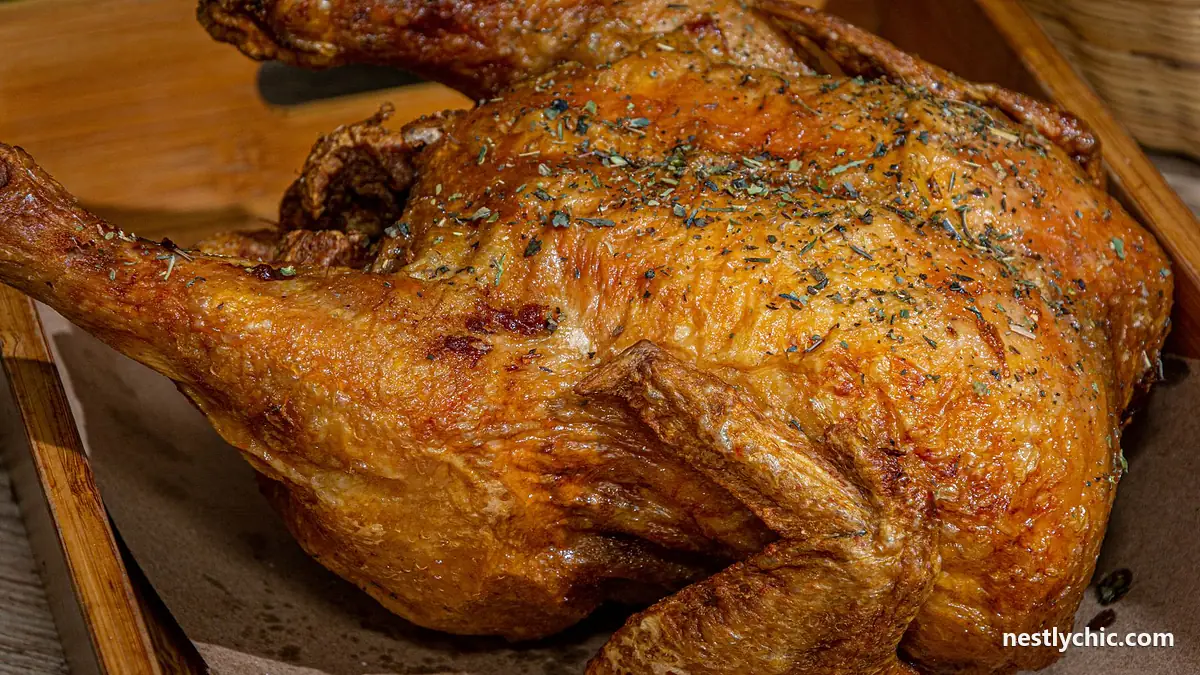
USDA's Food Safety and Inspection Service guidance for roasting a turkey is to place the bird breast-side up on a flat wire rack in a shallow roasting pan 2 to 2 1/2 inches deep.
That is shallower than most roasting pans sold, and the reason it is stated at all is that pan depth affects how heat and air reach the bird. A deep-sided pan shields the lower part of the bird, which changes how evenly it cooks.
So the sizing question is not "how big is my bird." It is: shallow enough to satisfy the guidance, large enough for the bird plus the rack, and small enough to fit the oven with air around it. Three constraints, and the third is the one that catches people out.
The measurement most people skip
Measure your oven before you buy a pan, not after.
You need three numbers, and the third is the important one:
The interior width of the oven, wall to wall.
The interior depth, front to back.
The clearance you will have left. A roasting pan that fits the oven exactly is a pan with no room for air to move around it, and no room for your hands, in oven gloves, to lift it while it is full and hot.
That last one is not a comfort point, it is the safety constraint. A full roasting pan is heavy, the handles are short by design, and there is no way to reposition your grip once it is out.
Cabinet and cupboard dimensions are the second measurement that decides this, because a roasting pan that fits the oven still has to be stored somewhere for the other fifty-one weeks of the year. We set out which household dimensions are worth writing down once in the cabinet, drawer and counter dimensions that decide what fits.
What USDA's guidance actually specifies
Worth quoting rather than paraphrasing, because the pieces fit together.
The pan: a shallow roasting pan 2 to 2 1/2 inches deep.
The rack: a flat wire rack, with the bird breast-side up on it.
Liquid: USDA's guidance adds one-half cup of water to the bottom of the pan.
Foil: if desired, a tent of aluminum foil may be placed loosely over the breast for the first 1 to 1 1/2 hours, then removed for browning.
Doneness: the safe minimum internal temperature is 165 °F, and USDA's guidance is that once the thigh has reached 165 °F, the wing and the thickest part of the breast should be checked to confirm 165 °F throughout.
The rack is not optional in that guidance and it is the part people improvise. A bird sitting directly on the pan floor is in a different position relative to the heat than the guidance describes.
This site does not give cooking times, does not assess whether a specific bird is done, and does not publish any temperature except the one USDA states. Doneness is decided by a thermometer, and the figure above is USDA's rather than ours.
Sizing to the bird, without a table
No pan-size-to-bird-weight table appears here, because we did not find one published by a named authority and inventing one would be exactly the kind of figure this site refuses.
What you can do instead is arithmetic you can trust:
The bird has to sit on the rack with space around it. Not touching the pan walls.
The pan has to sit in the oven with space around it. Not touching the oven walls or the door.
Which means the oven, not the bird, is usually the binding constraint in a domestic kitchen, and it is why buying the largest pan available is a common and expensive mistake.
If you are buying for a specific occasion, the reliable method is to know the largest bird you would realistically cook, and check that it plus a rack fits inside the pan you are considering, in the shop, with the box's stated interior dimensions rather than its outside ones.
Do you need one at all
A genuine question, and for many households the answer is no.
A roasting pan comes out once or twice a year in most kitchens, which puts it firmly in the category of equipment worth thinking about before buying. Where a piece earns permanent cupboard space and where it does not is the subject of what to skip until you know how you actually cook, and the broader question of which pieces are worth buying once for a long time is in where to spend and where to save in a first kitchen.
What can substitute: a large shallow pan with a wire rack, provided it meets the depth guidance and holds the bird and the rack with clearance.
What cannot: anything without a rack, if you are following the USDA guidance above, and anything that does not leave air space in the oven.
Materials, briefly
Weight matters more than material here, because the pan will be lifted full and hot.
Handles matter more than most people expect. Short, tight handles on a heavy full pan are the practical failure point, and they are worth checking with two oven-gloved hands before purchase rather than after.
No brand or product is recommended on this site, and no price appears anywhere on it.
The buying checklist
| Check | Why |
|---|---|
| Interior depth of the pan | USDA's guidance is a shallow pan, 2 to 2 1/2 inches deep |
| Does it come with a flat wire rack | The guidance places the bird on one |
| Interior length and width of the pan | Must hold the largest bird you would cook, with space |
| Oven interior width and depth | The binding constraint in most kitchens |
| Clearance left in the oven | For airflow, and for gloved hands to lift it |
| Handles | Grippable with oven gloves, on a full hot pan |
| Where it will be stored | It lives in a cupboard most of the year |
FAQ
What size roasting pan do I need? Large enough for the bird and a flat wire rack with space around them, shallow enough to match USDA's guidance of a pan 2 to 2 1/2 inches deep, and small enough to leave clearance in your oven. The oven is usually the binding constraint.
How deep should a roasting pan be? USDA's guidance for roasting a turkey specifies a shallow roasting pan 2 to 2 1/2 inches deep.
Do I need a rack? USDA's guidance places the bird breast-side up on a flat wire rack in the pan. A bird sitting directly on the pan floor is not the arrangement that guidance describes.
Is there a chart of pan size by bird weight? Not one published by a named authority that we could find, which is why none appears here. Measure the bird plus the rack against the pan's interior dimensions instead.
What internal temperature does a turkey need? USDA states a safe minimum internal temperature of 165 °F, and its guidance is to check the wing and the thickest part of the breast as well as the thigh to confirm 165 °F throughout. This site publishes no cooking times and does not assess whether a specific bird is done.
Is it worth owning a roasting pan? For many households it comes out once or twice a year, which is a real argument for a substitute that meets the depth and rack requirements rather than a dedicated piece.
Sources: USDA Food Safety and Inspection Service, "Let's Talk Turkey: A Consumer Guide to Safely Roasting a Turkey", checked 2026-08-28, for the shallow roasting pan 2 to 2 1/2 inches deep, the flat wire rack and breast-side-up placement, the one-half cup of water, the loose foil tent for the first 1 to 1 1/2 hours, and the 165 °F safe minimum internal temperature with the instruction to check the wing and thickest part of the breast as well as the thigh. Our fetcher received an HTTP 403 from fsis.usda.gov on that date, so this guidance is reported from USDA's own indexed pages rather than from a page we opened directly, and is labeled as such; that is our retrieval failing rather than anything on USDA's side, and a writer with working access should replace this note with a direct read before publish. No pan-size-to-weight table is published here because none was found from a named authority. No price, dimension or capacity figure of our own appears anywhere on this page.